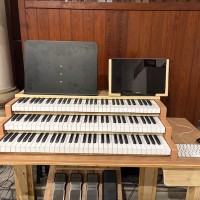
alextone wrote:I'd like to see the current organ expanded to include more stops, including a 64 ft stop for pedal (along with a couple more 32 and 16 stops), and a "celestial" set of stops for that ethereal cloud of sound over the might of the great and swell. In other words, i'm looking for a "thunderous" organ to use with an orchestra. The tutti options in the current organ are ok, but lack that "holy crap" astonishment of a mighty organ going full belt. CAVEAT: I'm using an organ as a concert instrument, not based on liturgical correctness.
I can but dream.
Alex.
I wonder who would be able to produce this in a home environment ?
If the question is taken in the sense of the acoustic wavelength (how large the sound wave spreads in the air), the following physical measured values result at room temperature and normal speed of sound in the air (c ≈ 343 m/s):
• Frequency: The generated sound is at extremely low approx. 8.2 Hertz. This is deep infrasound that humans can no longer hear, but can only feel as physical vibration in the body.
• Acoustic wavelength (λ): A complete vibration of this tone has a gigantic wavelength of about 42 meters in the air.
In order to the sound propagation for the aforementioned 64-foot organ register (frequency: 8.2 Hz, wavelength: approx. 42 meters), the following conditions apply physically:
1. The physical minimum (the limit frequency of space)
As soon as the largest dimension of a space (usually the diagonal) is smaller than half the wavelength (λ / 2) of a tone, the sound in space no longer behaves as a moving wave. The space then acts as a pressure chamber (pressure chamber effect).
• For the 8.2 Hz sound, this limit is approx. 21 meters.
• If the space in its longest extension is smaller than 21 meters, the wave of this organ register can no longer physically unfold as a wave in space.
2. The zone of the space modes (stading waves)
In order for a wave with a length of 42 meters to move at least somewhat as a wave, the space must at least correspond to the full wavelength. If the room size is exactly in the range of many times the wavelength, the rear wall throws the sound back so that the wave superimposes itself. Extreme space modes (standing waves) arise. In some places in the room the sound is then deafeningly loud (maximum sound pressure), in other places it is completely extinguished. There can be no question of an "unhindered" spread here.
3. When does the sound spread "unhindered"? (The free field)
A real, unhindered propagation as in the open field (acoustic free field) is defined in classical room acoustics via the so-called Schroeder limit frequency. Only far above this frequency do the sound waves spread statistically so densely and radially that the spatial sound is perceived as natural and unhindered.
• For normal frequencies, you already need concert halls.
• If you want to let a 42-meter wave spread in the room completely without reflection and unhindered (without the walls disturbing the sound field), the room would have to be several hundred meters in size in each direction, or the walls would have to be covered with meter-long wedge absorbers that swallow this frequency.
Conclusion: A room in which the infrasound of a 64-foot register can spread completely unhindered exists in buildings. Precisely for this reason, the few real 64-foot pipes in the world stand in gigantic halls such as the Boardwalk Hall in Atlantic City (USA), whose main hall has a volume of around 154,000 cubic meters to offer the gigantic sound the necessary space at all.
I think the 32 ft pipes in organteq are already stunning deep and full blast playing a tutti. Everything above seems overkill.
If I hit the 32 ft stop in my tiny 12 sqm / 27 m3 room its massive and like a punch in the face.
My subwoofer goes down to 22 hz i.e. I hear only half of the world:-)
As the room is so small it’s like a pressure chamber.
Tip:
Real vs. acoustic registers: The vast majority of 64-foot registers on paper are so-called acoustic registers (or "fakes" / results). They consist of a combination of a 32-foot register plus a fifth (21 1⁄3′) that produce the differential tone of a 64-foot tone in the brain.
Last edited by TimB3 (06-11-2026 14:56)