An iterative process is possible, which means there is a human factor /arbitrariness in the velocity response of each instrument preset. Then it is unlikely, that a one-fits-all, global velocity curve for an individual midi controller exists.
Isn't it human to assume that the middle velocity level is associated with the medium / standard / basic response of a virtual instrument? It wouldn't be rationale to think, that the medium response per design is chosen at low vel 32 or high vel 96 for example. But if humans are iterating it can happen, that one designer balances the medium response of a preset at 61 and the other at 66. Change your preferred velocity curve at mezzo-forte in this magnitude and a preset feels and sounds significantly different.
I have a steep hypothesis at the moment, that a physical background determines the mezzo-forte range of a midi controller:
It is at the point, where the key accelerates with 1G (= 9.81 m/s²)
Why? Based on the graph that has been mentioned in a parallel thread recently:
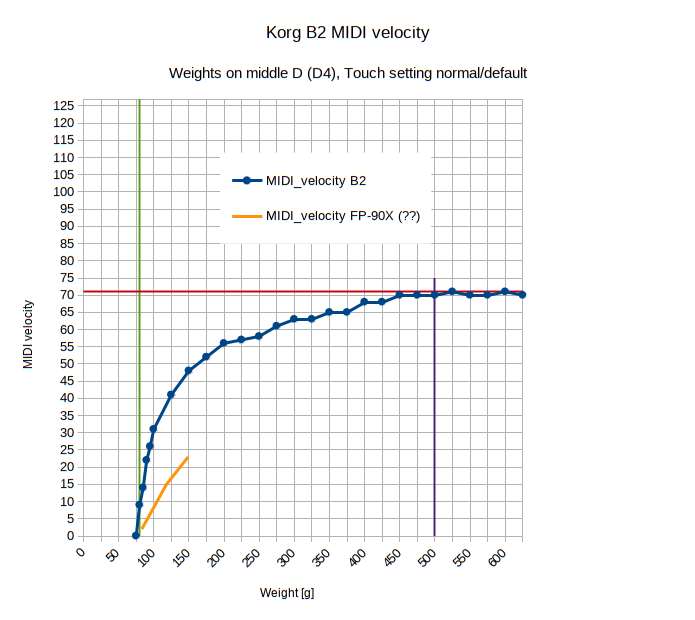
It seems that the muscle memory "feels" when the hand is accelerated with more than 1G (mf to fff) and slowed down with less than 1G (mp to ppp). From the graph I learned, that with a weight of >=500 g a key acceleration of 1G is reached with a common action. It might be more than a coincidence, that I had calibrated my velocity map just by ear and trial & error to vel 72 at mezzoforte (64) long before. Practically the same velocity ~70 that my midi controller outputs at 1G under factory-defaults.
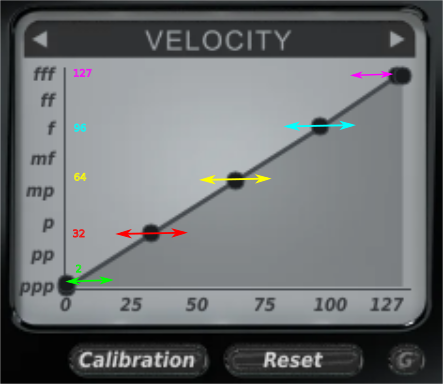
With this hypothesis the mezzoforte point (64) in the velocity curve can be mapped to the midi velocity at 1G (in this example 70 -> 64). The pianoteq calibration assistant calls this center point "normal touch, neither light nor strong" / "intermediate velocity".
But this is just one fixpoint of five used by the calibration assistant. Would be nice to deduce the other four points of the curve similarly, they seem to be less determined. For the lowest (controllable) velocity, I have chosen the point, where the rubberdome contact collapses under a static weight (can be felt with the fingertip, a bit like fake-let-off). With 100 g the rubber dome holds the weight, with 125 g it collapses (I don't take smaller intervals than 25 g for efficiency).
So I define that calibration point with 125 g.
A higher grade of arbitrariness has the calibration point "low velocity" "light, piano, touch". Between 125 g and 500 g I have chosen 250 g for this calibration point. It is in between the former values (of course) and the half of 500 g. And 125 g is the half of 250 g. I hope for some hidden math, that it makes some sense ;-), at least it provides a very similar value like my old trial & error curve.
The fff mapping is relatively uncomplicated, because my controller seems to be limited somewhere at 105.
You may ask at this point, where is calibration point 4, the forte f mapping? I have no idea at the moment, how to map this point other than trial & error ...