MbcCovers2 wrote:I'm currently an owner of Pianoteq 8 Stage and recently found out about the new updates, so I got Pianoteq 9 demo and tested it out a little bit, before deciding if upgrading to it or not.
...while this software is good as it is for many purposes, it also has a lot of potential for improvement.
...exactly one of the things I'd expect for a definitive/ultimate version of Pianoteq: more faithful bass notes.
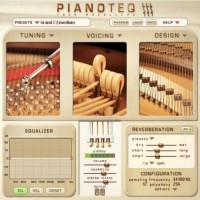
If you saw at first glance you became unhappy somehow with PIANOTEQ Stage, because you possibly cannot get —through equalization, EQ— its bass note to match another that’s from the sample library, just take a look at PIANOTEQ Standard or either PIANOTEQ PRO. See if either makes you happy.
Because lots of people at the forum can readily make parameter adjustments, so many as listeners can’t help but like the other versions more that offer such, and, when PIANOTEQ Stage won’t do. On either of the two EQ and EQUALIZATION are available and just so you get to hear the bass notes performed by and large differently from the factory presets within PIANOTEQ Stage.
For the comparison, I took and played a raw sample from a known free piano vst...
By whatever comparison of the notes struck from a single velocity, happily, a lot of course at this forum, in stark opposition to some outsiders, who supposedly are just as tech savvy, might had viewed PIANOTEQ very much the better representation. It’s the only out of the two anybody genuinely might had found preferable since he or she easily can get well over a thousand possible velocities out from whichever capable keyboard connected to PIANOTEQ software.
While this is just one of many comparisons we could make, I just did the simplest one because it actually shows pretty well the differences in sound, how the resonances fade and blend, the attack, and so on.
The samples typically found inside digital pianos and piano libraries (both) have often been recorded from nothing more than a paltry three (3) to five (5) velocities at a time. And, only a mere thirty percent (30%) of the keyboard notes from the acoustic piano instrument itself actually might ever end up in samples; the remaining percentage might had been derived from interpolation, a stretch of notes to digitally make others.
I've also read the comments in the forum and youtube videos, and noticed how there are people that really like Pianoteq sound, and some other people that call it "synthetic" or things like that.
About the bass notes and the rest, people again and again remark, they’re so synthetic sounding. I take such an inference as complementary!
When I was just a high school student I got to participate within a seminar run by the National Academy of Recording Arts and Sciences (NARAS). It included a wide introduction inside a pressing plant. Which made vinyl LP records for The Beatles, Iron Butterfly, John Denver, The Carpenters, Blood Sweat & Tears, Etc.
So, any sound of whatever music coming from vinyl to me, is without a doubt, matter-of-factly, something synthetic sounding. (Laugh.)
Abbey Road Vinyl
Whenever people criticize you and again say PIANOTEQ sounds too much like something synthetic to be of any good, maybe politely smile and let those continue to just rant and rave after you've slapped on a Waves Abbey Road Vinyl Plugin.
(Any of them play at a synthesizer by any chance?)
Before I forget, please let me welcome you to this forum...
Last edited by Amen Ptah Ra (10-11-2025 11:51)
Pianoteq 8 Studio Bundle, Pearl malletSTATION EM1, Roland (DRUM SOUND MODULE TD-30, HandSonic 10, AX-1), Akai EWI USB, Yamaha DIGITAL PIANO P-95, M-Audio STUDIOPHILE BX5, Focusrite Saffire PRO 24 DSP.