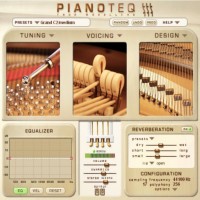
Topic: Something about the bass notes.

Hi
I'm currently an owner of Pianoteq 8 Stage and recently found out about the new updates, so I got Pianoteq 9 demo and tested it out a little bit, before deciding if upgrading to it or not.

I've also read the comments in the forum and youtube videos, and noticed how there are people that really like Pianoteq sound, and some other people that call it "synthetic" or things like that.

I'm making this post because I believe that, while this software is good as it is for many purposes, it also has a lot of potential for improvement.
Since I am not fan of describing sound with words, I recorded a video that shows exactly one of the things I'd expect for a definitive/ultimate version of Pianoteq: more faithful bass notes.

For the comparison, I took and played a raw sample from a known free piano vst, and played the same note in Pianoteq 9.
https://www.youtube.com/watch?v=NwqEBlLfNs8

While this is just one of many comparisons we could make, I just did the simplest one because it actually shows pretty well the differences in sound, how the resonances fade and blend, the attack, and so on.

Thanks for reading this and also for making Pianoteq, and good luck with the rest of the development.

Re: Something about the bass notes.

MbcCovers2 wrote:

Hi
I'm currently an owner of Pianoteq 8 Stage and recently found out about the new updates, so I got Pianoteq 9 demo and tested it out a little bit, before deciding if upgrading to it or not.

I've also read the comments in the forum and youtube videos, and noticed how there are people that really like Pianoteq sound, and some other people that call it "synthetic" or things like that.

I'm making this post because I believe that, while this software is good as it is for many purposes, it also has a lot of potential for improvement.
Since I am not fan of describing sound with words, I recorded a video that shows exactly one of the things I'd expect for a definitive/ultimate version of Pianoteq: more faithful bass notes.

For the comparison, I took and played a raw sample from a known free piano vst, and played the same note in Pianoteq 9.
https://www.youtube.com/watch?v=NwqEBlLfNs8

While this is just one of many comparisons we could make, I just did the simplest one because it actually shows pretty well the differences in sound, how the resonances fade and blend, the attack, and so on.

Thanks for reading this and also for making Pianoteq, and good luck with the rest of the development.

You compare a stereo sound with a mono sound (there is obviously a big difference). You must find a pianoteq preset similar to the first sound. Shigeru or Kawai player are closer.

Last edited by YvesTh (28-10-2025 23:35)

Re: Something about the bass notes.

YvesTh wrote:

You compare a stereo sound with a mono sound (there is obviously a big difference). You must find a pianoteq preset similar to the first sound. Shigeru or Kawai player are closer.

I checked the Kawai and yes, it's closer to what I expect the piano sound to be.
It seems to have also more presence of harmonics when the note is sustained. May be worth buying (currently have Steinway and K2)

https://www.youtube.com/watch?v=8gLgFZ2Dm5g

Having said that, not sure about an audio being mono. If you mean the sampled audio being mono then it doesn't seem so (listening to it and watching obs sound bars, where the left channel is usually slightly louder than right channel, with some variations), unless you mean stereo width. For context, the real piano samples were recorded with a Tascam DR 40.

Last edited by MbcCovers2 (29-10-2025 01:28)

Re: Something about the bass notes.

MbcCovers2 wrote:

Something about the bass notes

I layer a digital piano with Pianoteq precisely to get the bass presence that Pianoteq lacks and also to get high-mid tones that 'sing' where Pianoteq still tends to sound a bit synthesized to my ear, especially at higher velocities.

I really like the layering setup I've developed but, as flexible and responsive/lively as Pianoteq is, if I had to choose one over the other I would still choose a good DP for the realism/impact of bass notes and the overall more satisfying - if a bit static - timbres

Re: Something about the bass notes.

Heya,

Individual notes of sample libraries will often sound more impressive (louder/richer/fuller) than Pianoteq. But your bass note example is a great illustration of where this difference comes from: post processing and reverb.

A lot of very high quality audio engineering went into making the raw recordings of a real piano (which to your ear, I predict, would sound really flat) into the rich and saturated sounds you hear - by carefully EQing, saturating and compressing the raw audio. The audio engineers of the sample library will make a trade-off between purity and quality of listening experience, and for the bass notes, will often err towards the latter because those have to sound "impressive".

Pianoteq does far less of that, its sound is much closer to a raw recording (I would really love it if a skilled audio engineer would compare raw recordings, Pianoteq output and processed recordings - I bet people would struggle to tell the difference between raw and Pianoteq).

The cost of that is that the post processing won't work well in every imaginable playing situation - for example, if you play very fast virtuosic passages, trills, or repeated notes, samples will start sounding muddy and/or robotic.

The other thing is that samples benefit from the resonances of their recording environment, which add a lot of flavour and warmth to the sound, separate from the instrument. Pianoteq's built in reverb is okayish but not as good as real reverb (or a high quality, dedicated reverb VST)

So, if you want to replicate the sound of a sample library, you should think of pianoteq's output as a "raw recording" to apply convincing reverb and post-processing to.

Re: Something about the bass notes.

MbcCovers2 wrote:

Having said that, not sure about an audio being mono.

I was talking about the pianoteq "NY steinway D mix" preset. It is not exactly mono but almost because the closest mic is mono, and it sound like a monoo file (sound in the middle of head).

Re: Something about the bass notes.

daniel_r328 wrote:

Heya,

Individual notes of sample libraries will often sound more impressive (louder/richer/fuller) than Pianoteq. But your bass note example is a great illustration of where this difference comes from: post processing and reverb.

A lot of very high quality audio engineering went into making the raw recordings of a real piano (which to your ear, I predict, would sound really flat) into the rich and saturated sounds you hear - by carefully EQing, saturating and compressing the raw audio. The audio engineers of the sample library will make a trade-off between purity and quality of listening experience, and for the bass notes, will often err towards the latter because those have to sound "impressive".

Pianoteq does far less of that, its sound is much closer to a raw recording (I would really love it if a skilled audio engineer would compare raw recordings, Pianoteq output and processed recordings - I bet people would struggle to tell the difference between raw and Pianoteq).

The cost of that is that the post processing won't work well in every imaginable playing situation - for example, if you play very fast virtuosic passages, trills, or repeated notes, samples will start sounding muddy and/or robotic.

The other thing is that samples benefit from the resonances of their recording environment, which add a lot of flavour and warmth to the sound, separate from the instrument. Pianoteq's built in reverb is okayish but not as good as real reverb (or a high quality, dedicated reverb VST)

So, if you want to replicate the sound of a sample library, you should think of pianoteq's output as a "raw recording" to apply convincing reverb and post-processing to.

I got Ocelot Octaver, pretty wild for this purpose

Re: Something about the bass notes.

daniel_r328 wrote:

Heya,

Individual notes of sample libraries will often sound more impressive (louder/richer/fuller) than Pianoteq. But your bass note example is a great illustration of where this difference comes from: post processing and reverb.

A lot of very high quality audio engineering went into making the raw recordings of a real piano (which to your ear, I predict, would sound really flat) into the rich and saturated sounds you hear - by carefully EQing, saturating and compressing the raw audio. The audio engineers of the sample library will make a trade-off between purity and quality of listening experience, and for the bass notes, will often err towards the latter because those have to sound "impressive".

Pianoteq does far less of that, its sound is much closer to a raw recording (I would really love it if a skilled audio engineer would compare raw recordings, Pianoteq output and processed recordings - I bet people would struggle to tell the difference between raw and Pianoteq).

The cost of that is that the post processing won't work well in every imaginable playing situation - for example, if you play very fast virtuosic passages, trills, or repeated notes, samples will start sounding muddy and/or robotic.

The other thing is that samples benefit from the resonances of their recording environment, which add a lot of flavour and warmth to the sound, separate from the instrument. Pianoteq's built in reverb is okayish but not as good as real reverb (or a high quality, dedicated reverb VST)

So, if you want to replicate the sound of a sample library, you should think of pianoteq's output as a "raw recording" to apply convincing reverb and post-processing to.

I would agree with a lot of this except for "I bet people would struggle to tell the difference between raw [samples] and Pianoteq". But I would choose a good hardware digital piano over either Pianoteq or any sampled VSTi because they generally blend sampling with modeling to get the best of both worlds and, critically, because the sound engine is developed in harmony (pun intended) with the keyboard and pedal actions and curves to give a consistent and unified feel. I own a number of higher-end piano VSTis and have never gotten any of them to play as satisfyingly as a DP. And I'm not even an especially virtuosic pianist or playing the most state-of-the-art DP available.

Re: Something about the bass notes.

brundlefly wrote:

But I would choose a good hardware digital piano over either Pianoteq or any sampled VSTi because they generally blend sampling with modeling to get the best of both worlds and, critically, because the sound engine is developed in harmony (pun intended) with the keyboard and pedal actions and curves to give a consistent and unified feel.

You take a position which appears argumentative.  Do you rule out manufactures began to incorporate their own modeling just to keep their enterprises competitive, and, especially after Modartt's unforeseeable lead  —in such innovation?  That which today has changed, abruptly, an industry as a whole.

I own a number of higher-end piano VSTis and have never gotten any of them to play as satisfyingly as a DP.

What do you mean?  Many of the posts seem to have nothing but praise and put playability (especially) in high regard...

If I were you and encountered a problem when I play with PIANOTEQ, I'd firstly consider the possibility of user error on my part. 

Although I am a drummer, I'm finding sounds from PIANOTEQ more than merely satisfactory! To me they're exhilarating!  (Smile.)

Last edited by Amen Ptah Ra (29-10-2025 23:33)
Pianoteq 8 Studio Bundle, Pearl malletSTATION EM1, Roland (DRUM SOUND MODULE TD-30, HandSonic 10, AX-1), Akai EWI USB, Yamaha DIGITAL PIANO P-95, M-Audio STUDIOPHILE BX5, Focusrite Saffire PRO 24 DSP.

Re: Something about the bass notes.

brundlefly wrote:

I would choose a good hardware digital piano over either Pianoteq or any sampled VSTi

That is interesting because that is so widely outside my own experience! I own one of the top-end Kawai DPs and, while I can appreciate the built-in sounds being a step above many stock sounds I've heard before, for me they don't even begin to compare with what I can get out of Pianoteq (after careful calibration of velocity curves and room correction, of course). Diff'rent strokes for diff'rent folks I guess!

Re: Something about the bass notes.

daniel_r328 wrote:
brundlefly wrote:

I would choose a good hardware digital piano over either Pianoteq or any sampled VSTi

That is interesting because that is so widely outside my own experience! I own one of the top-end Kawai DPs and, while I can appreciate the built-in sounds being a step above many stock sounds I've heard before, for me they don't even begin to compare with what I can get out of Pianoteq (after careful calibration of velocity curves and room correction, of course). Diff'rent strokes for diff'rent folks I guess!

Room EQ is sadly forgotten by most.

Re: Something about the bass notes.

Amen Ptah Ra wrote:

You take a position which appears argumentative.

It’s my experience and opinion; not sure what makes it especially argumentative…?

I’ve been recording and using synths for   38 years. I’m well aware of all the factors that go into getting good sound from a particular instrument in a particular context.

EDIT: The above was posted from my phone, and quickly. Now that I'm back at a keyboard, let me expand a little:

I'm tlaking about the overall. satisfaction I get from an instrument which is a combination of factors including it's responsivenees to key and pedal articulation (where I acknowledge Pianoteq really shines), the maleability/editability of its timbre (obviously another Pianoteq strength), it's consistency and predictability across the pitch and velocity spectrum (Pianoteq is also good here), the impression that the sound is organic/acoustic and not synthesized/electronic, a lack of any offending tonal characteristics that become (or remain) grating or disappointing over time, and the overall beauty of the timbre and the feeling that the instrument can really be made to 'sing'. It's in these tonal/timbral categories that Pianoteq  still falls short in my opinion, and those characteristics are some of the most important to my personal satisfaction with any instrument.

The OP and I are not the first to suggest that Pianoteq's bass range is not as satisfying as some of the sample-based options. And, as already metnioned, I still find it to be bit jangly/buzzy/synthetic in the upper mid-range at higher velocities, though it continues to improve with evey new release on both counts.

Just because Modartt is a leader in piano modeling technology doesn't mean that DP manufacturers aren't using it effectively and possibly with a more satisfying result in some respects because they are not relying on it exclusively.

Last edited by brundlefly (30-10-2025 21:35)

Re: Something about the bass notes.

A third and final comparison:
https://www.youtube.com/watch?v=fGfWKuxf4UU

The reason I'm showing this one is because, if you go a bit up in the range, the sound feels better overall, so if I stay away from the notes below C2 things should be ok.

Having said that. I came to the conclusion that if I want more "realism" or accuracy in terms of note per note sound, maybe I should switch to sampled libraries, but since I like Pianoteq as it is I will continue using it for now.

Re: Something about the bass notes.

MbcCovers2 wrote:

While this is just one of many comparisons we could make, I just did the simplest one because it actually shows pretty well the differences in sound, how the resonances fade and blend, the attack, and so on.

The sampled one seems muddy and over-processed.  It might lack any definition while the other, the one of PIANOTEQ, appears very robust and clearly resonates from a distinctive piano body.

A third and final comparison:

Let me see from the blind test; the last, PIANOTEQ...

The reason I'm showing this one is because, if you go a bit up in the range, the sound feels better overall, so if I stay away from the notes below C2 things should be ok.

Remember really you've no diagram depicting the exact position of the microphone from which the bass note of the sampled piano was recorded.

Possibly you should consider an upgrade to a standard or pro copy, if really you'd like to perform tweaks to the bass notes and get them to sound just as you like in any musical context, preferably, that is of course with the rest; the other notes played inside a piece of music.

Check out the following; including the audio example, the music from my custom PIANOTEQ piano preset (S. Erard {1848}):

brundlefly wrote:

...the impression that the sound is organic/acoustic and not synthesized/electronic, a lack of any offending tonal characteristics that become (or remain) grating or disappointing over time, and the overall beauty of the timbre and the feeling that the instrument can really be made to 'sing'. It's in these tonal/timbral categories that Pianoteq  still falls short in my opinion, and those characteristics are some of the most important to my personal satisfaction with any instrument.

Experiment, if you will, with Unison width followed by Unison Balance which can readily make the piano sound as if it's actually just singing to you.  You of course, whenever you make those parameter adjustments, have to make also changes to your soundboard, Resonance, Direct sound duration, and perhaps lastly Damping Duration.

Please, listen carefully to the preset example I've provided (below) as I believe both it'll demonstrate a piano performance that seems simply to sing and its bass notes which do come across loudly very much in a properly performed musical context  —via PIANOTEQ software.

Hopefully the two of you will let me know if indeed heard was any unpleasant bass note that's out of context or you fail at all to hear any singing specifically out of this example:


Casse Noisette Suite Op. 71, Part 1.


It's of five (5) well known pieces:

  1. Ouverture miniature

  2. Marche

  3. Danse de la fée dragée

  4. Trepac, danse russe

  5. Danse arabe


Which are from composer Tchaikovsky, Peter Ilich, 1840-1893 just as they were performed by pianist Eugen d'Albert, 10 April 1864 – 3 March 1932.

MIDI of this recording has been obtained by a piano roll furnished from SUPRA, Stanford University Piano Roll Archive Research portal.

For more information about ways it was obtained from the piano roll, please refer to this paper.

Last edited by Amen Ptah Ra (05-11-2025 16:49)
Pianoteq 8 Studio Bundle, Pearl malletSTATION EM1, Roland (DRUM SOUND MODULE TD-30, HandSonic 10, AX-1), Akai EWI USB, Yamaha DIGITAL PIANO P-95, M-Audio STUDIOPHILE BX5, Focusrite Saffire PRO 24 DSP.
Re: Something about the bass notes.

Amen Ptah Ra wrote:

MIDI of this recording has been obtained by a piano roll furnished from SUPRA, Stanford University Piano Roll Archive Research portal.

This is very interesting from a technical standpoint, but seems a particularly inappropriate choice of MIDI to demonstrate the expressiveness of Pianoteq. I actually listened to most of the recording before stopping to read the details of its source, and immediately sensed there was something oddly mechanical about the timing and dynamics of the performances. After reading that, I downloaded the file to have a look at it in my DAW.

By the nature of how it was generated, the MIDI suffers from a lot of quantizing of notes in chords to the same tick and velocity and even the durations seem unusually/artificially consistent. The expected rhythmic patterns and cadences of these familiar pieces are not well-represented by the velocities in many sections, and the range and variation of velocities overall is much lower than I would expect to see in a direct MIDI recording. I almost expected to find that the MIDI clock was only 48 or 96 PPQ; it's actually 600 which is a somewhat unsual value but sufficient if the full precision is actually being used.

In addition to the shortcomings of timing and velocities, the sustain messages are on/off only, the soft-pedal transitions are jarring, and the sound is panned noticably to the right, almost giving the impression that the left and right hand parts were generated by two different pianos or were recordeded separately with different microphones or in different acoustic spaces. I also noticed that both the left and right-hand parts are including the same pedal messages; this doesn' seem to be causing any particular problem for Pianoteq aside from possibly making the pedal noises louder, but it seems a significant ovesight in the preparation of the files, and would make me question how much care was taken in other parts of the process.

Even if the MIDI were a direct recording from a modern MIDI controller, accurately capturing all possible nuances of the performance, it would still have the shortcoming that the performer wasn't playing and responding to the particular behavior and sound of Pianoteq. Taking a MIDI performance that was recorded on one instrument and rendering it with another will always lose something in translation.

Bottom line, I'm sorry to say that this recording does not sound at all good to me and actually emphasizes Pianoteq's deficits.

Possibly I was mistaken, but I had previously gotten the impression somehow that you were a fairly accomplished pianist in your own right and should be able to make a far better 'first person' recording to show Pianoteq in the best possible light...?

Re: Something about the bass notes.

brundlefly wrote:

I layer a digital piano with Pianoteq precisely to get the bass presence that Pianoteq lacks and also to get high-mid tones that 'sing' where Pianoteq still tends to sound a bit synthesized to my ear, especially at higher velocities.

The whole point of my preset example in any event was to demonstrate PIANOTEQ is more than a mere satisfactory software and is by far enough to make melodies sound as though they'd been sung by a piano  —regardless of technical difficulties encountered from the antiquated piano roll (format) used by Stanford to derive MIDI and that was long ago possibly the only means available to record the piano performance out of any virtuoso who'd been a concert pianist of the1800s.  (By his own account Thomas Edison hadn't invented his phonograph and by then until he'd gotten well into 1877.)

So it is still, any possibly singing from the recorded piano you've neglected to address.

I really like the layering setup I've developed but, as flexible and responsive/lively as Pianoteq is, if I had to choose one over the other I would still choose a good DP for the realism/impact of bass notes and the overall more satisfying - if a bit static - timbres

Again my demonstration was intended as an example of some singing along to —and with— realistic bass tones coming out of the piano preset; just if you'd like somehow to reexamine the position which only you take at this thread that's now about what's apparently your issue: digital piano vs. software.  (Seems alone you introduced it at this thread.)

To me seems this thread about Something about the bass notes is just that; over bass and other notes which had been labeled synthetic previously at the forum.  Incidentally I'm saying, brundlefly, in a nutshell it really ain't about nobody's MIDI or how much it might've failed to satisfy everybody or you, uniquely  —and it is probably just like it ain't about the poor souls who —unlike you— couldn't afford the modern choice of exclusivity 'a good hardware digital piano' but instead had only to rely upon whatever pianos and piano rolls, any could've had a long time ago in the distant past.

Imagine if you can an era before, modern digital audio production, even machine mass production, but namely and conversely antebellum periods.

I'm tlaking [sic] about the overall. [sic] satisfaction I get from an instrument...

By the nature of how it was generated, the MIDI suffers from a lot...

But I would choose a good hardware digital piano over either Pianoteq or any sampled VSTi because they generally blend sampling with modeling to get the best of both worlds and, critically, because the sound engine is developed in harmony...

...with the keyboard and pedal actions and curves to give a consistent and unified feel.

Well perhaps you'll feel up to my challenge, just to let forum members hear directly from you, and your own ostensively more harmonious interpretation of the pieces; Ouverture miniature, Marche, Danse de la fée dragée, Etc.  More than just likely, forum members —and especially after people read this post— will want for themselves probably to hear how the expected rhythmic patterns and cadences of the familiar, truly, should sound whenever coming estimably from a piano performer who is admittedly an accomplished musician himself such as you are at the digital piano.  (About that and of which piano instrument adamantly you've just boasted).

What you say?

At this thread you often seem to bring to light or point out matters of personal accomplishments, as though only they've undoubtedly something to do with the bass notes  —to me seemingly singing.

...but I had previously gotten the impression somehow that you were a fairly accomplished pianist in your own right and should be able to make a far better 'first person' recording to show Pianoteq in the best possible light...?

It’s my experience and opinion...

I’ve been recording and using synths for   38 years. I’m well aware of all the factors...

Sure!  But, now appears the perfect time for you to shine in the spotlight!

Taking a MIDI performance that was recorded on one instrument and rendering it with another will always lose something in translation.

Just like what I already said; argumentative.

Though just to be fair, maybe you kindly could put up the far better illustrative audio example right about where your argument is currently.  (Smile.)

(I right now shall remain optimistic though the moderators can choose to censor or delete this post, entirely, because of simply cultural differences, language barriers, Etc.)

Last edited by Amen Ptah Ra (06-11-2025 16:26)
Pianoteq 8 Studio Bundle, Pearl malletSTATION EM1, Roland (DRUM SOUND MODULE TD-30, HandSonic 10, AX-1), Akai EWI USB, Yamaha DIGITAL PIANO P-95, M-Audio STUDIOPHILE BX5, Focusrite Saffire PRO 24 DSP.

Re: Something about the bass notes.

Amen Ptah Ra wrote:

So it is still, any possibly singing from the recorded piano you've neglected to address.

Suffice it to say, I belive it's not possible for the instrument to 'sing' if the performance doesn't. And even ignoring the glaring inadequacies of the MIDI, I found the sound pretty unappetizing overall, and few, if any, of the velocities were high enough relative to surrounding notes to really show off the impact of a solidly struck bass note. Sorry if that offends; it's just my opinion, and not meant to denigrate your production skills. You obviously experience it differently.

You began by accusing me of being argumentative when I was only stating what I personally prefer in a digital piano sound. Now you're rebutting my comments sentence by sentence and challenging me to some sort of musical dual which seems far more argumentative.

In fact I have relatively recently posted an example of the sound I get from a layered DP/Pianoteq setup alongside renderings of the same MIDI with Pianoteq and the DP alone for comparison. The composition and performance were my own. Despite my years of playing and composing, I'm not at all virtuosic in either regard. I'm not classically trained (or inclined, though my mother and sister played violin and viola professionally and the house was full of classical music as I was growing up), and don't read well at all, so producing my own performance of those pieces is not going to happen. In referring to my years of experience, I only meant to say that I believe my impression of Pianoteq's shortcomings are not likely due to my inability or lack of effort to get a more satisfactory sound from it. I'll grant it came out sounding curt and self-aggrandizing as I was trying to respond quickly on my cellphone as mentioned.

I'll let the rest of your musings go without comment, and hope that we can go both move on, sharing thoughts about all things piano- and Pianoteq- related with a mutually more amicable and respectful tone.

I'll just add one other thought which is that in the time that piano rolls were being recorded, I think most people's experience of music was through live perfromance rather than recording of any kind so I don't really see that the state of the art (or lack thereof) of recording at the time is really germaine to the topic. At the same time, I'll acjnowledge that my comments strayed from the very narrow discussion of bass-note timbres that the OP might have intended, and I apologize if I took the discussion too far off base (pun intended).

Peace,
Dave

Last edited by brundlefly (06-11-2025 20:02)

Re: Something about the bass notes.

brundlefly wrote:

In fact I have relatively recently posted an example of the sound I get from a layered DP/Pianoteq setup alongside renderings of the same MIDI with Pianoteq and the DP alone for comparison.

Could you reshare that? I'd like to have a listen

Re: Something about the bass notes.

daniel_r328 wrote:
brundlefly wrote:

In fact I have relatively recently posted an example of the sound I get from a layered DP/Pianoteq setup alongside renderings of the same MIDI with Pianoteq and the DP alone for comparison.

Could you reshare that? I'd like to have a listen

Not sure if there's a more artful way to link/embed a post but this should work (not as recent as I thought - April 3. Time flies):

https://forum.modartt.com/viewtopic.php...3#p1001443

Re: Something about the bass notes.

Thanks!

Re: Something about the bass notes.

MbcCovers2 wrote:

I'm currently an owner of Pianoteq 8 Stage and recently found out about the new updates, so I got Pianoteq 9 demo and tested it out a little bit, before deciding if upgrading to it or not.

...while this software is good as it is for many purposes, it also has a lot of potential for improvement.

...exactly one of the things I'd expect for a definitive/ultimate version of Pianoteq: more faithful bass notes.

If you saw at first glance you became unhappy somehow with PIANOTEQ Stage, because you possibly cannot get —through equalization, EQ— its bass note to match another that’s from the sample library, just take a look at PIANOTEQ Standard or either PIANOTEQ PRO.  See if either makes you happy. 

Because lots of people at the forum can readily make parameter adjustments, so many as listeners can’t help but like the other versions more that offer such, and, when PIANOTEQ Stage won’t do.  On either of the two EQ and EQUALIZATION are available and just so you get to hear the bass notes performed by and large differently from the factory presets within PIANOTEQ Stage.

For the comparison, I took and played a raw sample from a known free piano vst...

By whatever comparison of the notes struck from a single velocity, happily, a lot of course at this forum, in stark opposition to some outsiders, who supposedly are just as tech savvy, might had viewed PIANOTEQ very much the better representation.  It’s the only out of the two anybody genuinely might had found preferable since he or she easily can get well over a thousand possible velocities out from whichever capable keyboard connected to PIANOTEQ software.

While this is just one of many comparisons we could make, I just did the simplest one because it actually shows pretty well the differences in sound, how the resonances fade and blend, the attack, and so on.

The samples typically found inside digital pianos and piano libraries (both) have often been recorded from nothing more than a paltry three (3) to five (5) velocities at a time.  And, only a mere thirty percent (30%) of the keyboard notes from the acoustic piano instrument itself actually might ever end up in samples; the remaining percentage might had been derived from interpolation, a stretch of notes to digitally make others.

I've also read the comments in the forum and youtube videos, and noticed how there are people that really like Pianoteq sound, and some other people that call it "synthetic" or things like that.

About the bass notes and the rest, people again and again remark, they’re so synthetic sounding.  I take such an inference as complementary!

When I was just a high school student I got to participate within a seminar run by the National Academy of Recording Arts and Sciences (NARAS).  It included a wide introduction inside a pressing plant.  Which made vinyl LP records for The Beatles, Iron Butterfly, John Denver, The Carpenters, Blood Sweat & Tears, Etc.

So, any sound of whatever music coming from vinyl to me, is without a doubt, matter-of-factly, something synthetic sounding.  (Laugh.)

Abbey Road Vinyl

Whenever people criticize you and again say PIANOTEQ sounds too much like something synthetic to be of any good, maybe politely smile and let those continue to just rant and rave after you've slapped on a Waves Abbey Road Vinyl Plugin. 

(Any of them play at a synthesizer by any chance?)

Before I forget, please let me welcome you to this forum...

Last edited by Amen Ptah Ra (10-11-2025 11:51)
Pianoteq 8 Studio Bundle, Pearl malletSTATION EM1, Roland (DRUM SOUND MODULE TD-30, HandSonic 10, AX-1), Akai EWI USB, Yamaha DIGITAL PIANO P-95, M-Audio STUDIOPHILE BX5, Focusrite Saffire PRO 24 DSP.

Re: Something about the bass notes.

@Amen Ptah Ra
Once, some time ago, I went through the rabbit hole of spending much time tweaking Pianoteq to see how much "better" the sound could be, but it ended in having presets that were ok when playing midis but unusable when playing myself for some reason, so I may not upgrade to Standard yet.

Also, I just upgraded from Pianoteq 8 stage to 9. All I can say is that I'm happy with it, and during these days playing with it I understood that there will always be differences in between real instruments and plugins, and that is probably better to focus in the good things it has to offer (which are many) instead of very specific things that are far from defining the instrument as a whole.