Re: YFX Japanese Grand Piano

dikrek wrote:
Pianistically wrote:
Minoo wrote:

Nice!
I hope YFX keeps improving its default base sound and gets rid of the unwanted beats.

Pianoteq is pretty much the only piano software I genuinely enjoy using.
I love pianos with new age + classical sound.

In normal temperament beating is a normal behaviour  ;  On a real acoustic , notes in the middle register produce noticeable interference between partials  and also due to unison tuning , specially on a new piano . I would recommend changing the condition slider first , then change the unison ( particularly if you hear beating playing notes individually) and reduce sympathetic resonance .  Note that 2 persons doing the same test will have different perceptions as the response to frequencies vary from one person to the next . Also worth mentioning that a piano with no beating will sound sterile , inharmonicity and partials are part of the piano sound .  Cheers

In my YFX example earlier I’ve tweaked some settings - what would you improve?

https://pianoclack.s3.us-east-1.amazona...2-no-1.mp3

I just listened to the jazz preset that you tweeked and that grabbed
attention  , it’s really nice !! Congrats !

Re: YFX Japanese Grand Piano

Pianistically wrote:
Minoo wrote:
Pianistically wrote:

In normal temperament beating is a normal behaviour  ;  On a real acoustic , notes in the middle register produce noticeable interference between partials  and also due to unison tuning , specially on a new piano . I would recommend changing the condition slider first , then change the unison ( particularly if you hear beating playing notes individually) and reduce sympathetic resonance .  Note that 2 persons doing the same test will have different perceptions as the response to frequencies vary from one person to the next . Also worth mentioning that a piano with no beating will sound sterile , inharmonicity and partials are part of the piano sound .  Cheers

Beating is minimum in ideal pianos.
I hope the team review for the beatings and the piano tone.

Not sure what you call an ideal piano , but in well regulated piano you avoid beats with single notes but adjacent notes are inevitably beating in 12 tones equal temperament , this is not related to regulation as such , but its just a physic law , you can actually calculate it . Now , the fact of the matter is that reverb tend to make these beats more audible so if these frequencies are unpleasant to your ears , just tune the % of wet vs dry sound , it is a single parameter , given you do not hear them tween reverb is off .

If this behavior is considered normal for a piano, I have no objection.
But I think these are a few subtle programming bugs.
I simply brought it up so that the developers could investigate these beats.

For example I see beat (A4 tie B4) in default reverb preset and (B4 tie A4) in Clean Studio preset.

My opinion is that this shouldn't be the default behavior of presets. In the software world, we can aim for ideal behavior. We're not constrained by physical limitations.
Most people don't have the technical knowledge to adjust the parameters themselves.

Last edited by Minoo (08-11-2026 04:36)
Windows, Linux, Pianoteq

Re: YFX Japanese Grand Piano

Modartt Pianoteq Team,

Thank you so, so much for the amazing YFX piano. It is my new absolute favourite. You have done a wonderful job, especially with the attack evidenced most powerfully in the upper register.

I shall record something soon I think.

Thanks again,

Warmest regards,

Chris

Re: YFX Japanese Grand Piano

Once again, a very pleasant surprise with this new YFX model.
As always with their new pianos, the team at Modartt and their testers have done a remarkable job here. My thanks to them all.
The "YFX Pop," in particular, represents a major step forward and is a real joy to play compared to the YC5. As someone who uses all of the piano models in Pianoteq, I am very glad I added this one—it will certainly see plenty of use. Bravo!

Re: YFX Japanese Grand Piano

I agree with Sigasa and bm above.
YFX a fantastic instrument.Thank you Modartt!

I'm going to test all presets and my first test was with YFX with Strings pad.    (Changes: velocity 124, Vol. + 2,3, Limiter switch off, condition 12, unison width 1,18) DAW: Master vol. 0,0. Track 1 vol 2,3  Keyboard M-Audio key station 88  keyboard sensitivity neutral.

I can describe the feeling of strings like floating just below the piano notes. It has a dreamy quality, almost like a cinematic space where the notes fade in and leave a shimmering aftertaste. It feels alive, lovely when I play.
The sparkling, sharp YFX attack meets the soft, drawn-out aftertaste from the Strings Pad. Doesn't really sound like two separate instruments, but like the piano's own soundboard has been transformed into a string orchestra.
The sound fills the sides of the soundstage and leaves the center free for the piano's core, which gives a feeling of space and depth.
Have used Kawai often so far. Now my normal tool will be YFX

Recorded with headphones

https://forum.modartt.com/viewtopic.php?id=13591

All the best, everyone

Stig

Last edited by Pianoteqenthusiast (11-11-2026 16:46)

Re: YFX Japanese Grand Piano

sigasa wrote:

Modartt Pianoteq Team,

Thank you so, so much for the amazing YFX piano. It is my new absolute favourite. You have done a wonderful job, especially with the attack evidenced most powerfully in the upper register.

I shall record something soon I think.

Thanks again,

Warmest regards,

Chris

I agree.  this new piano is totally awesome.  I really like the Classical preset, with the delay turned off, and a couple other minor tweaks.  Pianoteq is a dream come true, and the dream just keeps getting sweeter.  Thanks Modartt for yes another wonderful instrument!

Re: YFX Japanese Grand Piano

Very well done, thanks Modartt !
I'm currently comparing Steinway D, Shigeru K, Bechstein, Bosendorfer and YFX.
It seems that Modartt is improving the way they map the set of piano parameters onto the equations of the sound engine. I mean, there is not only the sound variation due to the modelled instrument, there is something else... (may be some modelling methodology improvement?).
Indeed, focusing on medium and medium-high range, the Steinway's and SKEX have a nasal sound that you can hardly optimize with mics type & placement or EQ. Bechstein and Bosendorfer are much better in this respect, much less effort to have them sounding great.
YFX is another step up. Much more sound presence, spacialization and warmth. The nasal perception has almost completely disappeared.

All my comments apply to pianoteq restitution on internal piano speaker systems, using a Kawai CA63, and a Yamaha CLP895GP. Using headphones may come up with different conclusion.
The presets I'm using are "player", "warm" and "recording" with some adjustments.

Warm regards,
Stephane

Re: YFX Japanese Grand Piano

dikrek wrote:
Philippe Guillaume wrote:
dikrek wrote:

I did post in the FXP corner

Oh I missed it, thank you so much dikrek!

All good. As you can see my changes are very small. But the condition, stretch, unison, hammer hardness and symp are all increased vs defaults.

Chopin87 wrote:
Philippe Guillaume wrote:
Chopin87 wrote:

Maybe let's add this as a lovely default preset so even stage user can enjoy it?

What would you call this preset? "YFX Chamber Recording" could be good (several other instruments have a preset called Chamber Recording).

Yes, I think it fits the overall sound very well...


My naming convention is so notoriously bad, I just add roman numerals to the presets I modify.    .__.

FYI, YFX Chamber Recording added to version 9.3.1 released just now (see https://www.modartt.com/pianoteq_changes). Thank you dikrek for the settings and Chopin87 for the suggestion of adding this preset!

Re: YFX Japanese Grand Piano

Does anyone else notice an inconsistency in tone when playing forte or louder in the B-C-D an octave above middle C? It’s most pronounced on the C, a bit less on the B and a bit less still on the D. All three, to me, sound significantly brighter or “harder” than the few notes on either side of those three.

I’m still checking out the trial version of this instrument. I’ve heard this inconsistency in a couple of the YFX presets, but I just tried the new Chamber Recording one and it jumped out at me immediately. By contrast, middle C to A-440 sound a bit dull, like they won’t “bite” no matter how hard I hit them.

It could be the middle C to A440 that’s the inconsistent part. Playing softly across the whole range seems pretty even, but playing loudly it’s as if there is a kind of muffling over that range.

Re: YFX Japanese Grand Piano

Philippe Guillaume wrote:

FYI, YFX Chamber Recording added to version 9.3.1 released just now (see https://www.modartt.com/pianoteq_changes). Thank you dikrek for the settings and Chopin87 for the suggestion of adding this preset!

https://s101.picofile.com/d/G-RwsHY02CL...n6fH/2.mp4

Please see the video.
As you can see, I played all notes with velocity 65 in freepiano.
but C5 sounds heavier velocity.

Last edited by Minoo (19-11-2026 09:18)
Windows, Linux, Pianoteq

Re: YFX Japanese Grand Piano

Minoo wrote:
Philippe Guillaume wrote:

FYI, YFX Chamber Recording added to version 9.3.1 released just now (see https://www.modartt.com/pianoteq_changes). Thank you dikrek for the settings and Chopin87 for the suggestion of adding this preset!

https://s101.picofile.com/d/G-RwsHY02CL...n6fH/2.mp4

Please see the video.
As you can see, I played all notes with velocity 65 in freepiano.
but C5 sounds heavier velocity.

FWIW I didn’t do any per note edits. I only have Pianoteq 9 standard, not pro.

Re: YFX Japanese Grand Piano

dikrek wrote:
Minoo wrote:
Philippe Guillaume wrote:

FYI, YFX Chamber Recording added to version 9.3.1 released just now (see https://www.modartt.com/pianoteq_changes). Thank you dikrek for the settings and Chopin87 for the suggestion of adding this preset!

https://s101.picofile.com/d/G-RwsHY02CL...n6fH/2.mp4

Please see the video.
As you can see, I played all notes with velocity 65 in freepiano.
but C5 sounds heavier velocity.

FWIW I didn’t do any per note edits. I only have Pianoteq 9 standard, not pro.

Of course!
I compared your FXP (Japanese YFX Jazz Recording Redux) today.

Last edited by Minoo (19-11-2026 15:43)
Windows, Linux, Pianoteq

Re: YFX Japanese Grand Piano

Minoo wrote:
Philippe Guillaume wrote:

FYI, YFX Chamber Recording added to version 9.3.1 released just now (see https://www.modartt.com/pianoteq_changes). Thank you dikrek for the settings and Chopin87 for the suggestion of adding this preset!

https://s101.picofile.com/d/G-RwsHY02CL...n6fH/2.mp4

Please see the video.
As you can see, I played all notes with velocity 65 in freepiano.
but C5 sounds heavier velocity.

It gets more obvious with higher velocities. Here’s a simple MIDI file you can download and drag onto Pianoteq with YFX Chamber Recording selected to play natural notes G4 through F5 at velocities 65, 96 and 112.

Re: YFX Japanese Grand Piano

Minoo wrote:
Philippe Guillaume wrote:

FYI, YFX Chamber Recording added to version 9.3.1 released just now (see https://www.modartt.com/pianoteq_changes). Thank you dikrek for the settings and Chopin87 for the suggestion of adding this preset!

https://s101.picofile.com/d/G-RwsHY02CL...n6fH/2.mp4

Please see the video.
As you can see, I played all notes with velocity 65 in freepiano.
but C5 sounds heavier velocity.

the graph in audacity doesn't tell you much because its a stereo rendition and the total dBFS is not a linear sum of the channels of what you see on the graph. You need to show  LUFS which is the standard unit to measure volumes of stereo files.
Moreover all effects in presets with EQ , delay reverb etc  can affect the volume of individual notes : So I am not sure there is anything fundamentally wrong here.

Also , even without effects , the radiation of the soundboard , the mic placements and various parameters means that you shouldn't expect all notes to produce the same LUFS in an acoustic piano and consequently not in pianoteq.  Note that even in a standard edition you can change the volume note by note  and in pro you can change both timbre and volume at note level which more or less like a specific velocity curve for a given note.

Last edited by Pianistically (20-11-2026 01:18)

Re: YFX Japanese Grand Piano

Pianistically wrote:
Minoo wrote:
Philippe Guillaume wrote:

FYI, YFX Chamber Recording added to version 9.3.1 released just now (see https://www.modartt.com/pianoteq_changes). Thank you dikrek for the settings and Chopin87 for the suggestion of adding this preset!

https://s101.picofile.com/d/G-RwsHY02CL...n6fH/2.mp4

Please see the video.
As you can see, I played all notes with velocity 65 in freepiano.
but C5 sounds heavier velocity.

the graph in audacity doesn't tell you much because its a stereo rendition and the total dBFS is not a linear sum of the channels of what you see on the graph. You need to show  LUFS which is the standard unit to measure volumes of stereo files.
Moreover all effects in presets with EQ , delay reverb etc  can affect the volume of individual notes : So I am not sure there is anything fundamentally wrong here.

Also , even without effects , the radiation of the soundboard , the mic placements and various parameters means that you shouldn't expect all notes to produce the same LUFS in an acoustic piano and consequently not in pianoteq.  Note that even in a standard edition you can change the volume note by note  and in pro you can change both timbre and volume at note level which more or less like a specific velocity curve for a given note.

Thanks for your attention.
Audacity (or any other audio editor) should be included in every standard recording workflow.

There are noticeable velocity inconsistencies across some keys.
This issue shouldn't exist in the default preset.

It can easily be heard, just as it is in the video. I noticed it by ear at first. It looks like accent.
you can compare the velocity of C5 in the preset with for example Jazz preset.

‌

Windows, Linux, Pianoteq

Re: YFX Japanese Grand Piano

Pianistically wrote:

Also , even without effects , the radiation of the soundboard , the mic placements and various parameters means that you shouldn't expect all notes to produce the same LUFS in an acoustic piano and consequently not in pianoteq.

I noticed this when playing, and my concern is how it sounds, not how it measures. Certainly, acoustic pianos have individual variations. If an acoustic piano had this much difference in the sound of certain notes, I would say that piano was improperly regulated or voiced.

To my ears, it’s only partially the volume, and more the “hardness.” The overtones for C5 in particular seem to increase disproportionately with higher velocities in comparison to the same velocities on G4 or A4. As I said, I’m not claiming to know which is “wrong,” just that they don’t seem like they belong in the same piano. It makes playing awkward.

Re: YFX Japanese Grand Piano

Coises wrote:
Pianistically wrote:

Also , even without effects , the radiation of the soundboard , the mic placements and various parameters means that you shouldn't expect all notes to produce the same LUFS in an acoustic piano and consequently not in pianoteq.

I noticed this when playing, and my concern is how it sounds, not how it measures. Certainly, acoustic pianos have individual variations. If an acoustic piano had this much difference in the sound of certain notes, I would say that piano was improperly regulated or voiced.

To my ears, it’s only partially the volume, and more the “hardness.” The overtones for C5 in particular seem to increase disproportionately with higher velocities in comparison to the same velocities on G4 or A4. As I said, I’m not claiming to know which is “wrong,” just that they don’t seem like they belong in the same piano. It makes playing awkward.

Hi Mr. Coises.

Unfortunately, it seems the team isn't as responsive to feedback as it used to be...

Windows, Linux, Pianoteq

Re: YFX Japanese Grand Piano

Minoo wrote:
Coises wrote:
Pianistically wrote:

Also , even without effects , the radiation of the soundboard , the mic placements and various parameters means that you shouldn't expect all notes to produce the same LUFS in an acoustic piano and consequently not in pianoteq.

I noticed this when playing, and my concern is how it sounds, not how it measures. Certainly, acoustic pianos have individual variations. If an acoustic piano had this much difference in the sound of certain notes, I would say that piano was improperly regulated or voiced.

To my ears, it’s only partially the volume, and more the “hardness.” The overtones for C5 in particular seem to increase disproportionately with higher velocities in comparison to the same velocities on G4 or A4. As I said, I’m not claiming to know which is “wrong,” just that they don’t seem like they belong in the same piano. It makes playing awkward.

Hi Mr. Coises.

Unfortunately, it seems the team isn't as responsive to feedback as it used to be...

They do read the forum but the proper way to get something fixed if you suspect a bug is to contact Modartt support! Every time I've contacted them they were super fast.

Re: YFX Japanese Grand Piano

dikrek wrote:

They do read the forum but the proper way to get something fixed if you suspect a bug is to contact Modartt support! Every time I've contacted them they were super fast.

I hope they at least check the issues...

Windows, Linux, Pianoteq

Re: YFX Japanese Grand Piano

Minoo wrote:
dikrek wrote:

They do read the forum but the proper way to get something fixed if you suspect a bug is to contact Modartt support! Every time I've contacted them they were super fast.

I hope they at least check the issues...

they do - did you contact support?

Re: YFX Japanese Grand Piano

Coises wrote:
Pianistically wrote:

Also , even without effects , the radiation of the soundboard , the mic placements and various parameters means that you shouldn't expect all notes to produce the same LUFS in an acoustic piano and consequently not in pianoteq.

I noticed this when playing, and my concern is how it sounds, not how it measures. Certainly, acoustic pianos have individual variations. If an acoustic piano had this much difference in the sound of certain notes, I would say that piano was improperly regulated or voiced.
To my ears, it’s only partially the volume, and more the “hardness.” The overtones for C5 in particular seem to increase disproportionately with higher velocities in comparison to the same velocities on G4 or A4. As I said, I’m not claiming to know which is “wrong,” just that they don’t seem like they belong in the same piano. It makes playing awkward.

This problem has been around for a long time.For example, on Shigeru Kawai. Notes sounded louder in the small octave F#-G#.I thought there was a problem with the keyboard.But the notes sounded more resonant compared to other notes when pressed the same way.Then it turned out that the problem appeared when the Dynamics parameter (45) was increased.I corrected these notes in Note Edit.In the YFX above, too, certain notes ring louder than others.Some might say that you can change everything in the settings.But I'm not an expert in this matter.There is no such thing on acoustics.
Another issue is the noise that occurs after a note is pressed. I don’t understand this! I’ve never heard the sound of hammers striking or the noise of a pedal being pressed when a grand piano is played on stage... Yes, I disable this in the settings. Why is it enabled by default? (F# major forte 2 octaves on staccato..... Preset YFX)

Last edited by Mr.st.andy (21-11-2026 06:03)
Kawai VPC1|Pianoteq Pro|Focusrite Scarlett 18i8|KRK ROKIT RP103 G4

Re: YFX Japanese Grand Piano

dikrek wrote:
Minoo wrote:
dikrek wrote:

They do read the forum but the proper way to get something fixed if you suspect a bug is to contact Modartt support! Every time I've contacted them they were super fast.

I hope they at least check the issues...

they do - did you contact support?

They say we forward problem.

but... the developer team may not pay attention really.

Windows, Linux, Pianoteq

Re: YFX Japanese Grand Piano

Coises wrote:

It gets more obvious with higher velocities. Here’s a simple MIDI file you can download and drag onto Pianoteq with YFX Chamber Recording selected to play natural notes G4 through F5 at velocities 65, 96 and 112.

Hello Coises,
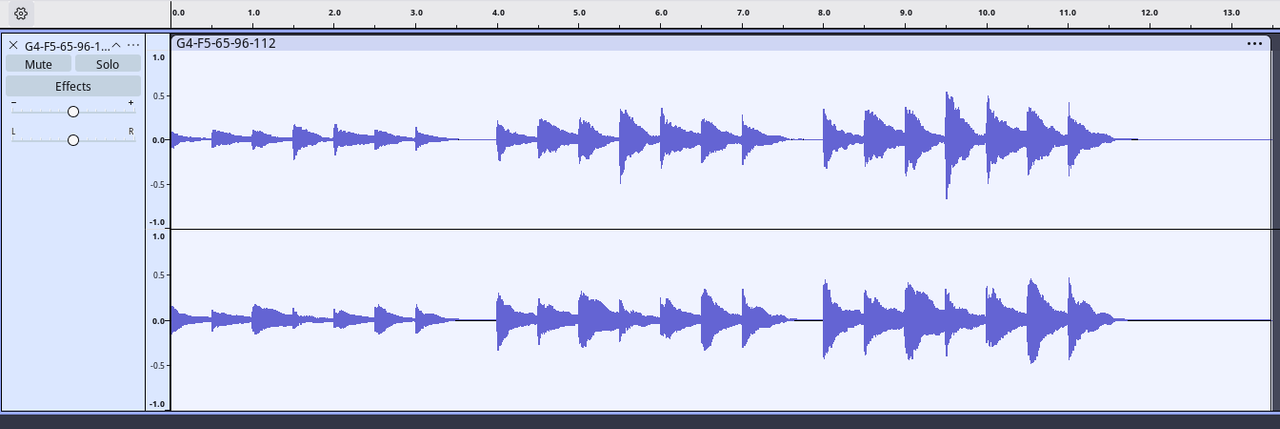
thank you for sharing that MIDI file. I rendered it with 'YFX Chamber Recording' to a WAV in Pianoteq 9.3.1 at 32bit/48000Hz:

https://i.postimg.cc/L62K0Z6X/G4-F5-65-96-112-YFX-Chamber-Recording.png

Volume differences in the stereo channels are generally not unusual in simulations of microphone recorded pianos. How much of that differences are audible is another question. I took 400 ms of each of the 7 notes you played with velocity 112 and tried to reference the perceived loudness relative to -14 LUFS:

x = Note at velocity 112
y = dB relative to -14 LUFS

G4   -3.01
A4   -2.63
B4   -0.47
C5   -1.29
D5   -1.51
E5   +0.31
F5   -2.47

But I'm not sure if my improvised method is valid, because I have no working LUFS plugin available in my (Linux) audacity. But audacity has the effect 'Loudness normalization' (to LUFS). Before and after I normalized 400 ms of each note to -14 LUFS I checked the gain to 0 dB with the effect 'Amplify'. The difference of these two gains are the dB relative to -14 LUFS the original recording had. These values are shown in my table.

Non-linearities exist in human hearing, the reproduction with speakers, headphones, room situations. How did you listen in your sessions, Coises? With headphones? Than you could try to flip L and R by turning the headphone. Outcome of that experiment?

Last edited by groovy (21-11-2026 11:51)

Re: YFX Japanese Grand Piano

groovy wrote:
Coises wrote:

It gets more obvious with higher velocities. Here’s a simple MIDI file you can download and drag onto Pianoteq with YFX Chamber Recording selected to play natural notes G4 through F5 at velocities 65, 96 and 112.

Hello Coises,
thank you for sharing that MIDI file. I rendered it with 'YFX Chamber Recording' to a WAV in Pianoteq 9.3.1 at 32bit/48000Hz:

https://i.postimg.cc/L62K0Z6X/G4-F5-65-96-112-YFX-Chamber-Recording.png

Volume differences in the stereo channels are generally not unusual in simulations of microphone recorded pianos. How much of that differences are audible is another question. I took 400 ms of each of the 7 notes you played with velocity 112 and tried to reference the perceived loudness relative to -14 LUFS:

x = Note at velocity 112
y = dB relative to -14 LUFS

G4   -3.01
A4   -2.63
B4   -0.47
C5   -1.29
D5   -1.51
E5   +0.31
F5   -2.47

But I'm not sure if my improvised method is valid, because I have no working LUFS plugin available in my (Linux) audacity. But audacity has the effect 'Loudness normalization' (to LUFS). Before and after I normalized 400 ms of each note to -14 LUFS I checked the gain to 0 dB with the effect 'Amplify'. The difference of these two gains are the dB relative to -14 LUFS the original recording had. These values are shown in my table.

Non-linearities exist in human hearing, the reproduction with speakers, headphones, room situations. How did you listen in your sessions, Coises? With headphones? Than you could try to flip L and R by turning the headphone. Outcome of that experiment?

if your test is valid , data interpretation shows that the loudest note is E5 and not C5 and that the difference of C5 with its adjacent notes are 0.82 and 0,22 . Lufs delta are in dB  0.22 is beyond the audible limit by human ear and .82 is very difficult to perceive if not trained .Ill run a test tonight on my side as a matter of curiosity . But for sure analysing the delta like you did is the right approach . Worth doing the test with and without effects turned on  as well .

Last edited by Pianistically (21-11-2026 14:52)

Re: YFX Japanese Grand Piano

Pianistically wrote:

if your test is valid , data interpretation shows that the loudest note is E5 and not C5 and that the difference of C5 with its adjacent notes are 0.82 and 0,22 . Lufs delta are in dB  0.22 is beyond the audible limit by human ear and .82 is very difficult to perceive if not trained .Ill run a test tonight on my side as a matter of curiosity . But for sure analysing the delta like you did is the right approach . Worth doing the test with and without effects turned on  as well .


C5 in my video file acts as Accent note:
https://s101.picofile.com/d/G-RwsHY02CL...n6fH/2.mp4

Windows, Linux, Pianoteq

Re: YFX Japanese Grand Piano

Minoo wrote:
Pianistically wrote:

if your test is valid , data interpretation shows that the loudest note is E5 and not C5 and that the difference of C5 with its adjacent notes are 0.82 and 0,22 . Lufs delta are in dB  0.22 is beyond the audible limit by human ear and .82 is very difficult to perceive if not trained .Ill run a test tonight on my side as a matter of curiosity . But for sure analysing the delta like you did is the right approach . Worth doing the test with and without effects turned on  as well .


C5 in my video file acts as Accent note:
https://s101.picofile.com/d/G-RwsHY02CL...n6fH/2.mp4

Hello !
Sorry I might be going off-topic, but in Pianoteq, the volume isn't linear. When you look at the volume section with "note edit," there are volume variations on each note, some more significant than others. For the "YFX Chamber Recording" preset, note C5 is boosted by 2.8 dB and note E5 by 0.1 dB. That's a difference of 2.7 dB, which might be audible to some people.

Here are the volume values for all the piano notes in the preset.

Volume = [-1.7, -2.6, -2.2, -1.3, -2.8, -2.2, -2.0, -1.6, -1.8, -2.2, -1.7, -1.5, -1.6, -1.5, -0.7, -0.4, +0.6, +1.0, +0.9, -1.1, -0.4, +1.0, +0.4, -2.6, -2.6, -1.1, -0.8, -0.7, +0.5, +0.4, +0.1, -1.2, -1.1, -0.6, -1.6, -2.8, -0.7, -1.1, -0.4, -1.3, 0, +0.5, -1.2, -3.0, -0.7, -2.7, -1.2, -3.2, -0.9, -2.4, +0.2, -3.1, -0.9, +0.3, -1.1, -4.4, -2.4, -3.9, -0.8, -2.6, -0.8, +0.5, +1.8, +2.8, -1.5, +2.8, +3.2, +0.1, -2.9, -4.2, +1.6, +2.6, +3.5, -2.6, -2.4, +0.2, -1.6, +0.2, -0.7, -0.4, -0.7, -0.5, -0.4, +1.5, -2.6, -3.6, -1.3, -2.0, +2.5, -3.7, -0.6, -2.9, 0, -2.9, -1.3, -2.3, -1.5, -2.5, -0.6, -2.2, -3.4, -4.2, -2.7, -3.4, -2.5]

You can test the notes that have a lot of variations to see if that's your issue.

Re: YFX Japanese Grand Piano

Here the value of integrated LUFS per note (BS.1770, K-weighted, stereo) at the different velocities with the YFX Chamber Recording with effects enabled in the preset and without presets . Velocity curve linear.  Volume adjustments left as is in the preset.

With effects enabled ( values from F4 to G5 , white notes only)

                         
Notes          G4       A4        B4        C5       D5       E5        F5
                 
Velocity 65    -27.5    -26.6    -23.4    -26.2    -25.3    -25.1    -27.2
Velocity 96    -21.4    -20.5    -18.1    -20.0    -19.6    -18.2    -20.8
Velocity 112    -18.4    -17.5    -15.1    -16.9    -16.7    -15.0    -17.9


With effects disabled ( values from F4 to G5 , white notes only)

Velocity 65    -26.3    -26.7    -24.6    -25.5    -26.6    -27.9    -26.6
Velocity 96    -20.4    -20.7    -19.7    -19.6    -21.1    -21.2    -20.4
Velocity 112    -17.5    -17.6    -16.7    -16.7    -18.1    -18.0    -17.5

Comments:
The lower the values is the louder the notes are.
With effects :  at (65,96)  B4 is the loudest note at (112)  E5 is the loudest
Without effects :  at (65) B4 is the loudest  at (96) C5 is the loudest , only 0.1 difference with B4 , at (112) both B4 and C5 have the same value

The overall amplitude of LUFS at a  given velocity is completely comparable with what would you measure on acoustic. A piano that would give the same absolute value for the same given force on all notes would actually sound boring and flat.

Conclusion :  It is a storm in a cup of tea -  I also wonder why black notes were not tested...

Cheers to all

Last edited by Pianistically (21-11-2026 22:44)

Re: YFX Japanese Grand Piano

I'm a new PianoTeq user and so don't have any experieince with how they run their shop. Is this likely to be fixed? I am really interested in adding the YFX to my collection, but now that I've heard this issue, i can't un-hear it and i know I'll be unhappy until it's resolved.

Re: YFX Japanese Grand Piano

Pianistically, how many milliseconds of each note have you analyzed?

Re: YFX Japanese Grand Piano

Brian_NOTL wrote:

I'm a new PianoTeq user and so don't have any experieince with how they run their shop. Is this likely to be fixed? I am really interested in adding the YFX to my collection, but now that I've heard this issue, i can't un-hear it and i know I'll be unhappy until it's resolved.

In my experience (not all that extensive, but I have been using Pianoteq for several years now), the models usually improve over time. The changes are usually small (typically listed in the change logs as one or more models having been revoiced), but they make a difference.

I might have been a bit too harsh saying that I would consider an acoustic piano that sounded like this improperly voiced. It’s been a long time since I’ve had the opportunity to play an acoustic. It’s entirely possible that I have forgotten how much variation from note to note is normal.

The other day I noticed C5 on YFX Chamber Recording within moments of trying it. Today... I’m not sure I would have heard it if I didn’t already know it was there. Elusive thing, sound. What I hear today is B4 on the YFX Player preset. Trill C5/D5 at forte with the pedal down for reference, then try trilling B4/C5 forte with the pedal down and see if you can get the B4 not to stick out.

I recall being annoyed with some presets on the Bösendorfer when it first came out. It wasn’t volume there, it was stereo position. For some reason, B3 sounded far to the left of the notes around it. I found it distracting. (I play with two Genelec 8030c speakers set up as nearfield monitors.) If it’s still there at all, it’s so subtle that I can’t be sure I’m not imagining it. So, yes, in my experience the consistency of models does usually improve in the months following their first release.

Re: YFX Japanese Grand Piano

groovy wrote:

How did you listen in your sessions, Coises?

I have a pair of Genelec 8030c speakers set up as nearfield monitors (roughly 30 inches from my head and 36 inches apart) in an untreated room. Which is part of why I asked if others hear it. I know my setup is hardly a scientific test bed. (My ears are not what they used to be, either. That picture of me is forty years old.)

But a couple other people seem to hear it, too, and I trust hearing more than measurements. Not because I don’t “believe in” measurements, but because I know just enough to know that measuring things like this is not simple. I know I don’t know precisely what is different about C5, or how to measure it properly, just that it “sounds louder or brighter” than I would expect relative to the surrounding notes.

Last edited by Coises (Yesterday 03:03)

Re: YFX Japanese Grand Piano

JFabPiano wrote:

Hello !
Sorry I might be going off-topic, but in Pianoteq, the volume isn't linear. When you look at the volume section with "note edit," there are volume variations on each note, some more significant than others. For the "YFX Chamber Recording" preset, note C5 is boosted by 2.8 dB and note E5 by 0.1 dB. That's a difference of 2.7 dB, which might be audible to some people.

Here are the volume values for all the piano notes in the preset.

Volume = [-1.7, -2.6, -2.2, -1.3, -2.8, -2.2, -2.0, -1.6, -1.8, -2.2, -1.7, -1.5, -1.6, -1.5, -0.7, -0.4, +0.6, +1.0, +0.9, -1.1, -0.4, +1.0, +0.4, -2.6, -2.6, -1.1, -0.8, -0.7, +0.5, +0.4, +0.1, -1.2, -1.1, -0.6, -1.6, -2.8, -0.7, -1.1, -0.4, -1.3, 0, +0.5, -1.2, -3.0, -0.7, -2.7, -1.2, -3.2, -0.9, -2.4, +0.2, -3.1, -0.9, +0.3, -1.1, -4.4, -2.4, -3.9, -0.8, -2.6, -0.8, +0.5, +1.8, +2.8, -1.5, +2.8, +3.2, +0.1, -2.9, -4.2, +1.6, +2.6, +3.5, -2.6, -2.4, +0.2, -1.6, +0.2, -0.7, -0.4, -0.7, -0.5, -0.4, +1.5, -2.6, -3.6, -1.3, -2.0, +2.5, -3.7, -0.6, -2.9, 0, -2.9, -1.3, -2.3, -1.5, -2.5, -0.6, -2.2, -3.4, -4.2, -2.7, -3.4, -2.5]

You can test the notes that have a lot of variations to see if that's your issue.

C5 doesn't sound as it normally should.
It is played like an accent note.
heavy.

All settings should be correctly configured in the default presets.

Last edited by Minoo (Yesterday 06:56)
Windows, Linux, Pianoteq

Re: YFX Japanese Grand Piano

Coises wrote:
groovy wrote:

How did you listen in your sessions, Coises?

I have a pair of Genelec 8030c speakers set up as nearfield monitors (roughly 30 inches from my head and 36 inches apart) in an untreated room. Which is part of why I asked if others hear it. I know my setup is hardly a scientific test bed. (My ears are not what they used to be, either. That picture of me is forty years old.)

But a couple other people seem to hear it, too, and I trust hearing more than measurements. Not because I don’t “believe in” measurements, but because I know just enough to know that measuring things like this is not simple. I know I don’t know precisely what is different about C5, or how to measure it properly, just that it “sounds louder or brighter” than I would expect relative to the surrounding notes.

The best way is for everyone that hears it to send a message to support, not just on this forum.

Re: YFX Japanese Grand Piano

As all experienced Pianoteq users know, we always listen to them. The new Chamber preset is an example: it was suggested by dikrek here, and added as a new preset to the YFX within a couple of weeks. It didn't go through the usual beta process, which explains why a few details need to be corrected. Do not worry, it will be fixed in the next update. If you notice other such issues, please write to the support https://www.modartt.com/support, we usually reply within 48 hours. I would like to remind the purpose of this forum (see https://forum.modartt.com/register, logout first ro read it): The purpose of this forum is to work as a helpful community between Pianoteq users, sharing their knowledge and ideas, it is not a support place.

Re: YFX Japanese Grand Piano

Philippe Guillaume wrote:

As all experienced Pianoteq users know, we always listen to them. The new Chamber preset is an example: it was suggested by dikrek here, and added as a new preset to the YFX within a couple of weeks. It didn't go through the usual beta process, which explains why a few details need to be corrected. Do not worry, it will be fixed in the next update. If you notice other such issues, please write to the support https://www.modartt.com/support, we usually reply within 48 hours. I would like to remind the purpose of this forum (see https://forum.modartt.com/register, logout first ro read it): The purpose of this forum is to work as a helpful community between Pianoteq users, sharing their knowledge and ideas, it is not a support place.

All users have the same goal: to help improve and develop the software.

We love your products.
Mr. Niclas is a very kind and helpful person.
I'm in contact with him for a long time.
He knows me well.

‌

Windows, Linux, Pianoteq

Re: YFX Japanese Grand Piano

JFabPiano wrote:
Minoo wrote:
Pianistically wrote:

if your test is valid , data interpretation shows that the loudest note is E5 and not C5 and that the difference of C5 with its adjacent notes are 0.82 and 0,22 . Lufs delta are in dB  0.22 is beyond the audible limit by human ear and .82 is very difficult to perceive if not trained .Ill run a test tonight on my side as a matter of curiosity . But for sure analysing the delta like you did is the right approach . Worth doing the test with and without effects turned on  as well .


C5 in my video file acts as Accent note:
https://s101.picofile.com/d/G-RwsHY02CL...n6fH/2.mp4

Hello !
Sorry I might be going off-topic, but in Pianoteq, the volume isn't linear. When you look at the volume section with "note edit," there are volume variations on each note, some more significant than others. For the "YFX Chamber Recording" preset, note C5 is boosted by 2.8 dB and note E5 by 0.1 dB. That's a difference of 2.7 dB, which might be audible to some people.

Here are the volume values for all the piano notes in the preset.

Volume = [-1.7, -2.6, -2.2, -1.3, -2.8, -2.2, -2.0, -1.6, -1.8, -2.2, -1.7, -1.5, -1.6, -1.5, -0.7, -0.4, +0.6, +1.0, +0.9, -1.1, -0.4, +1.0, +0.4, -2.6, -2.6, -1.1, -0.8, -0.7, +0.5, +0.4, +0.1, -1.2, -1.1, -0.6, -1.6, -2.8, -0.7, -1.1, -0.4, -1.3, 0, +0.5, -1.2, -3.0, -0.7, -2.7, -1.2, -3.2, -0.9, -2.4, +0.2, -3.1, -0.9, +0.3, -1.1, -4.4, -2.4, -3.9, -0.8, -2.6, -0.8, +0.5, +1.8, +2.8, -1.5, +2.8, +3.2, +0.1, -2.9, -4.2, +1.6, +2.6, +3.5, -2.6, -2.4, +0.2, -1.6, +0.2, -0.7, -0.4, -0.7, -0.5, -0.4, +1.5, -2.6, -3.6, -1.3, -2.0, +2.5, -3.7, -0.6, -2.9, 0, -2.9, -1.3, -2.3, -1.5, -2.5, -0.6, -2.2, -3.4, -4.2, -2.7, -3.4, -2.5]

You can test the notes that have a lot of variations to see if that's your issue.

. Volume has probably been humanised with the random function in pianoteq which is done in a few presets . Actually looking at the values, D5 and A5 have even higher values . In all cases any adjustment should be done depending on the keyboard you use , as even linear curves on digital piano are never truly linear because ok friction not being identical from one key to the next  so you need to consider the whole chai ie  DP (linear curves on digital) + pianoteq and adjusted velocity curve  to get the touch and feel you want and finally adjust outlaws  notes if any . I also agree with some comments that some humanisation is necessary for  a VSTi not to sound too synthetics.  .

Re: YFX Japanese Grand Piano

Philippe Guillaume wrote:

As all experienced Pianoteq users know, we always listen to them. The new Chamber preset is an example: it was suggested by dikrek here, and added as a new preset to the YFX within a couple of weeks. It didn't go through the usual beta process, which explains why a few details need to be corrected. Do not worry, it will be fixed in the next update. If you notice other such issues, please write to the support https://www.modartt.com/support, we usually reply within 48 hours. I would like to remind the purpose of this forum (see https://forum.modartt.com/register, logout first ro read it): The purpose of this forum is to work as a helpful community between Pianoteq users, sharing their knowledge and ideas, it is not a support place.

FYI all, no randomisation or per note editing was used in my preset (beyond what may have already been there in the Jazz preset I used as a starting point).

I didn’t hear these note discrepancies others mention, but

1. Many MIDI controllers are themselves poorly regulated and often accentuate notes
2.  Not everyone has the same sensitivity to these things
3. Noticeable during playing vs testing a MIDI file outputting the same exact velocity per key are two different things.

To be noticeable during playing, you’d need

1. Perfectly calibrated controller
2. Excellent hearing
3. Perfect touch control
4. Most importantly: a preset that’s really inaccurate

Last edited by dikrek (Yesterday 17:31)

Re: YFX Japanese Grand Piano

groovy wrote:

x = Note at velocity 112
y = dB relative to -14 LUFS

G4   -3.01
A4   -2.63
B4   -0.47
C5   -1.29
D5   -1.51
E5   +0.31
F5   -2.47

But I'm not sure if my improvised method is valid, because I have no working LUFS plugin available in my (Linux) audacity. But audacity has the effect 'Loudness normalization' (to LUFS). Before and after I normalized 400 ms of each note to -14 LUFS I checked the gain to 0 dB with the effect 'Amplify'. The difference of these two gains are the dB relative to -14 LUFS the original recording had. These values are shown in my table.

The upper method has been valid, with the DAW Ardour and its 'Loudness Analysis' I found the same LUFS in the example WAV: 

x = Note at velocity 112
y = LUFS (Momentary)

G4   -17.0
A4   -16.6
B4   -14.5
C5   -15.3
D5   -15.5
E5   -13.7
F5   -16.5

Re: YFX Japanese Grand Piano

Minoo wrote:
JFabPiano wrote:

Hello !
Sorry I might be going off-topic, but in Pianoteq, the volume isn't linear. When you look at the volume section with "note edit," there are volume variations on each note, some more significant than others. For the "YFX Chamber Recording" preset, note C5 is boosted by 2.8 dB and note E5 by 0.1 dB. That's a difference of 2.7 dB, which might be audible to some people.

Here are the volume values for all the piano notes in the preset.

Volume = [-1.7, -2.6, -2.2, -1.3, -2.8, -2.2, -2.0, -1.6, -1.8, -2.2, -1.7, -1.5, -1.6, -1.5, -0.7, -0.4, +0.6, +1.0, +0.9, -1.1, -0.4, +1.0, +0.4, -2.6, -2.6, -1.1, -0.8, -0.7, +0.5, +0.4, +0.1, -1.2, -1.1, -0.6, -1.6, -2.8, -0.7, -1.1, -0.4, -1.3, 0, +0.5, -1.2, -3.0, -0.7, -2.7, -1.2, -3.2, -0.9, -2.4, +0.2, -3.1, -0.9, +0.3, -1.1, -4.4, -2.4, -3.9, -0.8, -2.6, -0.8, +0.5, +1.8, +2.8, -1.5, +2.8, +3.2, +0.1, -2.9, -4.2, +1.6, +2.6, +3.5, -2.6, -2.4, +0.2, -1.6, +0.2, -0.7, -0.4, -0.7, -0.5, -0.4, +1.5, -2.6, -3.6, -1.3, -2.0, +2.5, -3.7, -0.6, -2.9, 0, -2.9, -1.3, -2.3, -1.5, -2.5, -0.6, -2.2, -3.4, -4.2, -2.7, -3.4, -2.5]

You can test the notes that have a lot of variations to see if that's your issue.

C5 doesn't sound as it normally should.
It is played like an accent note.
heavy.

All settings should be correctly configured in the default presets.

In Note Edit I've lowered the value for Volume (selected in the drop down menu ) to -1.0 dB, which makes C5 more equal to the next notes. And saved the preset as Chamber Recording C5. I'm sure in a future update it will be corrected . It's a very nice preset and sounds especially nice when  playing it in a daw with a reverb by Convology XT -German 140Unit St-Small hall. Just load the Chopin nocturne 19 midi file (see earlier in this thread ) to listen.