Topic: Vidal MIDI piano controller--user review

I’ve had my Vidal keyboard long enough now to offer my reflections on how it plays and feels to a piano lover. In short, it has far exceeded my expectations and hopes for a portable piano keyboard.

This is a keyboard for a serious pianist: its action, feel and dynamic response are very close to that of a full sized (7’) acoustic grand, when used to control a piano VST such as Pianoteq. It will feel completely familiar to a player who has developed their technique on acoustic grands. This includes details such as key angle and pivot point of both whites and sharps, key displacement, feeling of inertia and weight through downstroke and recovery, minimal key bounce on release, ease of repetitions, key-to-key uniformity and a hard-to-describe general feeling of solidity and quality. To me, with its accurate piano action and its absence of buttons, wheels, lights, knobs, and displays, it feels and acts like an instrument more than an electronic device.

I’ve been wishing for something like the Vidal for a very long time…a portable piano that doesn’t require compromises to piano technique that I’ve worked on for over 50 years (I’m an old guy!). At home, I play a 7’ grand (1970 Baldwin SF10 with Renner action, well-regulated, recent new hammers and dampers), whose key lengths are probably very close to that of the Vidal, so I’ve done much back and forth comparison since receiving my Vidal. I’ve also performed on many other grands over the years, from my early days of student recitals to current regular jazz gigs, including Steinways, Yamahas, and others in varying condition. For gigs at venues without pianos, I have used several other digital pianos and controllers (with Pianoteq). All of these can work well, but they don’t really feel accurately like a good piano, and they just can’t support the same technique used on a good piano. I freely admit that this is just my opinion, but it’s always felt like a compromise to me to not be playing an acoustic grand.  I’m saying all of this to provide some context as to why this Vidal keyboard has been so transformative for me. To me, expecting a piano under my hands, it just feels right and plays right.

Here are a few other observations:

The dynamic response, the touch, player command of the keyboard are just like a good piano. I know…hard to accept without trying it, but here goes. For live piano sounds, I’m most familiar with Pianoteq, and try to get the dynamics of various DPs or controllers to match the dynamic response of Pianoteq modeled pianos, until they “feel” like a real piano, from ppp to fff. This usually involves remapping the keyboard velocity onto Pianoteq response. The Vidal requires ZERO remapping of velocity, for Pianoteq models or for any piano VST I’ve tried so far.  I’m guessing that this means the Vidal keyboard accurately matches the piano keyboard actions that were used to create the piano models (Pianoteq) or sample layers (sample libraries) in the first place. If I set the Pianoteq dynamics setting at about 50dB (default is 40), it honestly feels like a live piano to me, if the output volume in headphones or speakers is set to a real level.

An orientation touchstone for me when I sit at the piano, whether it’s my own piano or an unfamiliar one, is to find that equilibrium point at which my arms-hands-fingers are weighted exactly on the keys, so I feel like I’m floating weightlessly on the keyboard. Effortless to depress a key, and it feels like the key “lifts” my fingers back up, no matter how light or heavy the action. Then I’m connected to the instrument and can access its dynamic range. For whatever reason, maybe the mechanics or counterweighting or springs or my own failure, I haven’t been able to find that pianistic state with a portable keyboard.  With the Vidal, it’s there! Equilibrium point and access to the whole range of dynamics.

I can work on piano technique on the Vidal. I now trust its response and evenness of action to to the extent that I have been playing exercises, working on touch and tone development (in Pianoteq at least), and practicing challenging passages, knowing it’s transferable to playing on a real piano. I’ve never felt that before with a DP or MIDI controller. To play ppp or mf or fff passages with complete control as intended…incredible. It also has made me aware of the expressive potential of Pianoteq that I was missing out on because of the limitations of the keyboards I was using. Now I find myself playing the Vidal at home, with various Pianoteq models, just for pure pleasure.

The mechanical noise of the Vidal is different from an acoustic piano. If you aren’t listening to its sound output, you will hear some thumping of keys bottoming. Probably not louder than a grand action whose strings are silenced, or a DP with the power off.

The Vidal is heavy, about 90 lb. The full length wood keys (ebony sharps!), solid wood cabinet, and steel balance weights all add up, but that’s also what adds to the feeling of solidity and stability when playing. No problem if it’s going to be your home or studio instrument, but If the aim is to use it as a portable piano, you’ll need a case, wheeled cart, and a partner to help with lifting. 

The Vidal is crafted in small numbers in a shop in Philadelphia from top grade materials, so it’s necessarily more expensive than most commercially manufactured alternatives, with a different target market. If you’re in the US and can visit their shop, that’s probably the best way to determine whether the Vidal is for you. In my opinion, the Vidal represents a compact instrument for pianists who want a MIDI controller with the feel, control and responsiveness of a grand.

Last edited by TimN (10-07-2025 14:56)

Re: Vidal MIDI piano controller--user review

TimN wrote:

I’ve had my Vidal keyboard long enough now to offer my reflections on how it plays and feels to a piano lover. In short, it has far exceeded my expectations and hopes for a portable piano keyboard.

What a great review and comments!

I ordered/bought a Vidal when they were taking initial pre-orders for the first batch (a year and a few months ago) and look forward to receiving it. They are a small business-team/workshop and have spent a great deal of time developing and prototyping the device/instrument. I subscribe to the PlayVidal.com blog and their Instagram account. Last blog was in January, 2025 and latest Instagram post in April, 2025.

Although I haven't heard from them yet, I'm guessing they will contact me by email when my order has reached the top of their fulfillment list, for shipping details, etc. I'd rather be a patient than insistent customer, but will probably contact them within weeks to a few months to check that my name and order hasn't been misplaced or lost.

Anyway, it's very nice to read comments about the Vidal from a long-time pianist.

Last edited by Stephen_Doonan (10-07-2025 19:30)
--
Linux, Mac OS, Pianoteq Pro, Organteq, Vidal MIDI controller

Re: Vidal MIDI piano controller--user review

Congrats to Vidal for delivering another keyboard, again to rave reviews. I also ordered one from the first batch and continue to look forward eagerly to it. Obviously they are taking much longer to produce than they had hoped, which must be a source of anxiety for the business (as well as to its patient early supporters!). But if they can make this work financially, this promises to be a breakthrough for the industry.

Re: Vidal MIDI piano controller--user review

TimN wrote:

I’ve had my Vidal keyboard long enough now to offer my reflections on how it plays and feels to a piano lover. In short, it has far exceeded my expectations and hopes for a portable piano keyboard.

This is a keyboard for a serious pianist: its action, feel and dynamic response are very close to that of a full sized (7’) acoustic grand, when used to control a piano VST such as Pianoteq. It will feel completely familiar to a player who has developed their technique on acoustic grands. This includes details such as key angle and pivot point of both whites and sharps, key displacement, feeling of inertia and weight through downstroke and recovery, minimal key bounce on release, ease of repetitions, key-to-key uniformity and a hard-to-describe general feeling of solidity and quality. To me, with its accurate piano action and its absence of buttons, wheels, lights, knobs, and displays, it feels and acts like an instrument more than an electronic device.

I’ve been wishing for something like the Vidal for a very long time…a portable piano that doesn’t require compromises to piano technique that I’ve worked on for over 50 years (I’m an old guy!). At home, I play a 7’ grand (1970 Baldwin SF10 with Renner action, well-regulated, recent new hammers and dampers), whose key lengths are probably very close to that of the Vidal, so I’ve done much back and forth comparison since receiving my Vidal. I’ve also performed on many other grands over the years, from my early days of student recitals to current regular jazz gigs, including Steinways, Yamahas, and others in varying condition. For gigs at venues without pianos, I have used several other digital pianos and controllers (with Pianoteq). All of these can work well, but they don’t really feel accurately like a good piano, and they just can’t support the same technique used on a good piano. I freely admit that this is just my opinion, but it’s always felt like a compromise to me to not be playing an acoustic grand.  I’m saying all of this to provide some context as to why this Vidal keyboard has been so transformative for me. To me, expecting a piano under my hands, it just feels right and plays right.

Here are a few other observations:

The dynamic response, the touch, player command of the keyboard are just like a good piano. I know…hard to accept without trying it, but here goes. For live piano sounds, I’m most familiar with Pianoteq, and try to get the dynamics of various DPs or controllers to match the dynamic response of Pianoteq modeled pianos, until they “feel” like a real piano, from ppp to fff. This usually involves remapping the keyboard velocity onto Pianoteq response. The Vidal requires ZERO remapping of velocity, for Pianoteq models or for any piano VST I’ve tried so far.  I’m guessing that this means the Vidal keyboard accurately matches the piano keyboard actions that were used to create the piano models (Pianoteq) or sample layers (sample libraries) in the first place. If I set the Pianoteq dynamics setting at about 50dB (default is 40), it honestly feels like a live piano to me, if the output volume in headphones or speakers is set to a real level.

An orientation touchstone for me when I sit at the piano, whether it’s my own piano or an unfamiliar one, is to find that equilibrium point at which my arms-hands-fingers are weighted exactly on the keys, so I feel like I’m floating weightlessly on the keyboard. Effortless to depress a key, and it feels like the key “lifts” my fingers back up, no matter how light or heavy the action. Then I’m connected to the instrument and can access its dynamic range. For whatever reason, maybe the mechanics or counterweighting or springs or my own failure, I haven’t been able to find that pianistic state with a portable keyboard.  With the Vidal, it’s there! Equilibrium point and access to the whole range of dynamics.

I can work on piano technique on the Vidal. I now trust its response and evenness of action to to the extent that I have been playing exercises, working on touch and tone development (in Pianoteq at least), and practicing challenging passages, knowing it’s transferable to playing on a real piano. I’ve never felt that before with a DP or MIDI controller. To play ppp or mf or fff passages with complete control as intended…incredible. It also has made me aware of the expressive potential of Pianoteq that I was missing out on because of the limitations of the keyboards I was using. Now I find myself playing the Vidal at home, with various Pianoteq models, just for pure pleasure.

The mechanical noise of the Vidal is different from an acoustic piano. If you aren’t listening to its sound output, you will hear some thumping of keys bottoming. Probably not louder than a grand action whose strings are silenced, or a DP with the power off.

The Vidal is heavy, about 90 lb. The full length wood keys (ebony sharps!), solid wood cabinet, and steel balance weights all add up, but that’s also what adds to the feeling of solidity and stability when playing. No problem if it’s going to be your home or studio instrument, but If the aim is to use it as a portable piano, you’ll need a case, wheeled cart, and a partner to help with lifting. 

The Vidal is crafted in small numbers in a shop in Philadelphia from top grade materials, so it’s necessarily more expensive than most commercially manufactured alternatives, with a different target market. If you’re in the US and can visit their shop, that’s probably the best way to determine whether the Vidal is for you. In my opinion, the Vidal represents a compact instrument for pianists who want a MIDI controller with the feel, control and responsiveness of a grand.
Great review and I am sure it feels great to own a  hand made keyboard that your neighbour is unlikely to have . This  is something unique . The big plus imho is the facility to access the keys  at the difference of main stream keyboards where you have to unscrew tons of nuts and as a premium lose the guarantee . The big downside is the price ; where I live , you can buy 2 x brand new NV5S Kawai equipped with a true acoustic action ( ~2600 euros)  ( Vidal being 5600 euros) so what gives ?

Last edited by Pianistically (10-07-2025 19:27)

Re: Vidal MIDI piano controller--user review

Just received my Vidal MIDI controller keyboard (prepared excellently for shipment in a plywood crate with rigid foam/spacers inside)  and very impressed with the excellent, meticulous craftsmanship and especially with the action, which is different from (and better than, in my opinion so far, because it feels more like an acoustic piano) any action I've played on another digital piano or MIDI controller.

Initial impressions and thoughts, and a couple minor initial issues, here:

https://vi-control.net/community/thread...rd.171189/


https://i.imgur.com/JfPkxtY.jpeg

Last edited by Stephen_Doonan (28-03-2026 15:08)
--
Linux, Mac OS, Pianoteq Pro, Organteq, Vidal MIDI controller

Re: Vidal MIDI piano controller--user review

Hi Stephen,

Your triple pedal looks very similar to the Studiologic SLP-3D that I use with my Studiologic SL88 Grand keyboard. Is it the same one?
Do you plug it straight in the Vidal ?

Last edited by Gaston (29-03-2026 16:26)

Re: Vidal MIDI piano controller--user review

Gaston wrote:

Hi Stephen,

Your triple pedal looks very similar to the Studiologic SLP-3D that I use with my Studiologic SL88 Grand keyboard. Is it the same one?
Do you plug it straight in the Vidal ?

The Studologic SLP3D is (as of November, when I got my Vidal) the only triple pedal Vidal currently supports (plugged directly into it, that is).

(I will also write up a report on the Vidal soon.)

Re: Vidal MIDI piano controller--user review

Gaston wrote:

Hi Stephen,

Your triple pedal looks very similar to the Studiologic SLP-3D that I use with my Studiologic SL88 Grand keyboard. Is it the same one?
Do you plug it straight in the Vidal ?

Yes, It is the StudioLogic SLP-3D. The only other triple pedal (continuous or half-damper sustain, sostenuto and una corda) that I know of that I'm guessing would work with the Vidal is the Nord TP1, because like the StudioLogic it uses a single TRS (tip/ring/sleeve) plug, which is what the Vidal supports.

https://www.nordkeyboards.com/accessori...pedal-tp1/

The SLP-3D triple pedal works great with the Vidal, which sends MIDI CC 64 (sustain), CC 66 (sostenuto) and CC67 (una corda) on each of the three pedals from right to left without modification or MIDI translation. The Nord TP2, unlike the TP1 and the SLP-3D, sends continuous data (0-127 MIDI values) on all three pedals, whereas the SLP-3D and TP1 send continuous data only for the sustain pedal (to enable half-pedaling), while the sostenuto and una corda pedals of each of those brands are simple on/off switches (0 or 127 MIDI value).

Last edited by Stephen_Doonan (29-03-2026 17:41)
--
Linux, Mac OS, Pianoteq Pro, Organteq, Vidal MIDI controller

Re: Vidal MIDI piano controller--user review

Thans Smulloni & Stephen !

Well, so I already own the triple pedal; all I need now is the Vidal — it's just a minor detail !

Re: Vidal MIDI piano controller--user review

that is indeed a beautiful axe.  would love to try one of those.  but the rest of your setup looks awesome too, would love more info.  that wireless keyboard looks quite chonky!

Re: Vidal MIDI piano controller--user review

budo wrote:

that is indeed a beautiful axe.  would love to try one of those.  but the rest of your setup looks awesome too, would love more info.  that wireless keyboard looks quite chonky!


The Keyboard is a Keychron K2 wireless (2.4GHz with radio-receiver dongle, or Bluetooth) with Hall effect (magnetic) switches:

https://www.keychron.com/products/keych...6762963033


The mouse is a Kensington Expert Moust wireless trackball (I've used a trackball instead of a regular mouse for I guess about 2 decades):

https://www.kensington.com/p/products/e...rackball-1


Other gear:


Apple Mac Studio:

https://www.apple.com/mac-studio/


OWS Express 1M2 external hard disk:

https://www.owc.com/solutions/express-1m2


Papritech AirMotion Pro, wireless (Bluetooth) MIDI breath controller:

https://www.papritech.com/airmotion-pro


MIDI Expression iO, 4-port MIDI pedal hub from AudioFront.net:

https://www.audiofront.net/MIDIExpression.php


MIDI hub (4-in, 4-out MIDI + USB-to-computer) from Blokas.io:

https://blokas.io/midihub/

--

Last edited by Stephen_Doonan (30-03-2026 14:50)
--
Linux, Mac OS, Pianoteq Pro, Organteq, Vidal MIDI controller

Re: Vidal MIDI piano controller--user review

Beautiful MIDI-controller and furniture. Probably one of the best in its class. Thanks for your first hand impressions, Stephen!

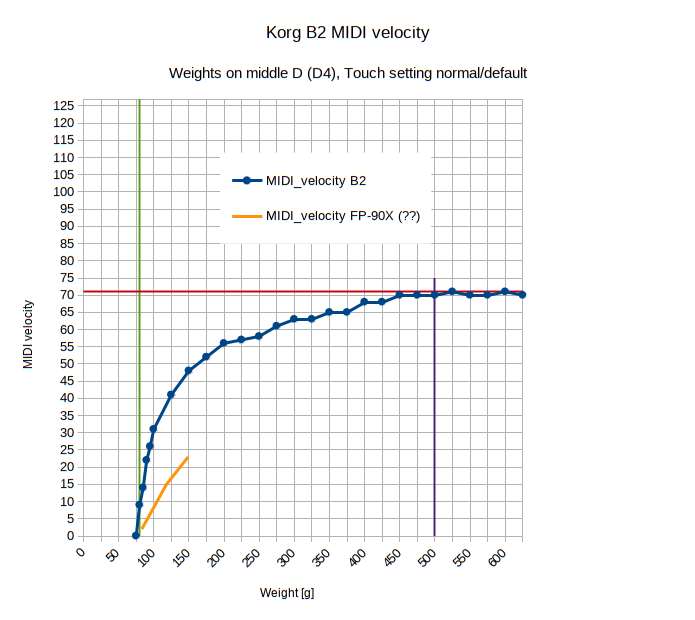
At the end it generates MIDI velocities. I have not found any hard facts about the specs so far. One typical fingerprint of a keyboard is the MIDI velocity value at the acceleration of gravity, which is 9,81 m/s². A good approximation is easy with a weight of >= 500 g placed on one key. For standardisation at the factory-default velocity curve (often called 'Normal') and in the middle of the keyboard e.g. C4).

More information found in the velocitester-tread beginning here:
https://forum.pianoworld.com/ubbthreads...ost3258601
https://forum.pianoworld.com/ubbthreads...ost3259475

Maybe you can share some time for this simple "drop-test" with a 500 g weight on one middle white key of the Vidal.

Re: Vidal MIDI piano controller--user review

groovy wrote:

...
At the end it generates MIDI velocities. I have not found any hard facts about the specs so far. One typical fingerprint of a keyboard is the MIDI velocity value at the acceleration of gravity, which is 9,81 m/s². A good approximation is easy with a weight of >= 500 g placed on one key. For standardisation at the factory-default velocity curve (often called 'Normal') and in the middle of the keyboard e.g. C4).

Maybe you can share some time for this simple "drop-test" with a 500 g weight on one middle white key of the Vidal.

A 500 gram calibration weight is typically about 1.5 inches in diameter, which is wider than a white key of a piano, so it would need to be placed on top of a lighter cylinder or block that is smaller than the width of a piano key--

Last edited by Stephen_Doonan (31-03-2026 13:50)
--
Linux, Mac OS, Pianoteq Pro, Organteq, Vidal MIDI controller

Re: Vidal MIDI piano controller--user review

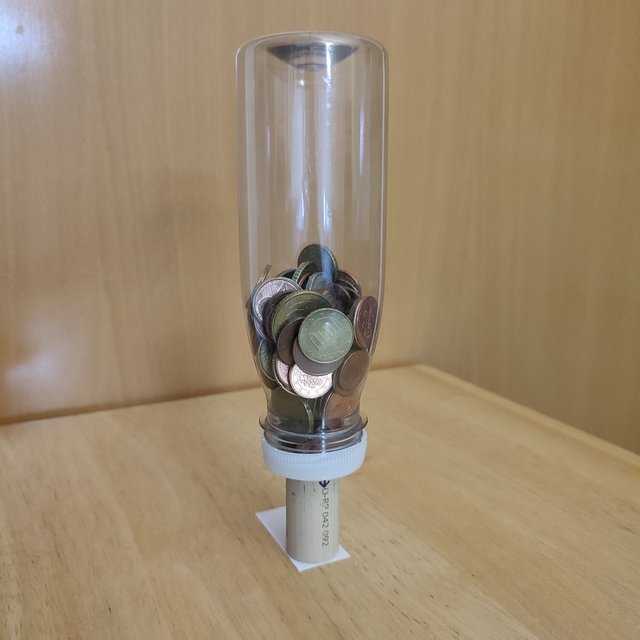
Yes, needs some creativity. For example a small bottle with water will do. An eraser rubber underneath for the ~1 cm key dip and soft contact to the key surface. It does not need to be exactly 500 g, every weight >= 500 g will do to achieve the quasi-constant (earth-)acceleration of 9,81 m/s² (vulgo 1G), which makes the conditions comparable to other midi controllers.

Re: Vidal MIDI piano controller--user review

groovy wrote:

Yes, needs some creativity. For example a small bottle with water will do. An eraser rubber underneath for the ~1 cm key dip and soft contact to the key surface. It does not need to be exactly 500 g, every weight >= 500 g will do to achieve the quasi-constant (earth-)acceleration of 9,81 m/s² (vulgo 1G), which makes the conditions comparable to other midi controllers.


Have you done this test on the MIDI controller keyboard or MIDI digital piano you use? If so, could you mention the brand and model of that MIDI controller/digital-piano and post a link to those test results, or a screenshot or video of a test performed at the MIDI Velocity Tester website?

https://velocitester.com/

---

Last edited by Stephen_Doonan (31-03-2026 16:59)
--
Linux, Mac OS, Pianoteq Pro, Organteq, Vidal MIDI controller

Re: Vidal MIDI piano controller--user review

Yes, it is all documented in the thread I have already linked.

No need for the velocitester tool here. Pianoteq contains an elaborated MIDI monitor,
which is more than enough to record the MIDI velocity of a single note C4 under a weight of ~ 500 g.

Please don't feel under pressure, if you don't like to do that little experiment. It's completely ok.

Cheers

Last edited by groovy (31-03-2026 17:23)

Re: Vidal MIDI piano controller--user review

groovy wrote:

Yes, it is all documented in the thread I have already linked.

No need for the velocitester tool here. Pianoteq contains an elaborated MIDI monitor,
which is more than enough to record the MIDI velocity of a single note C4 under a weight of ~ 500 g.

Please don't feel under pressure, if you don't like to do that little experiment. It's completely ok.

Cheers

I think it's an interesting experiment and one that I would like to try. Thanks for the suggestion. I wouldn't be surprised if there are some inconsistencies of MIDI-value registration between keys; I doubt that any MIDI controller keyboards or digital pianos are perfect or ideal in this regard, but it would be interesting to check the MIDI-sensor responses for various keys.

Are you user "Myon" at pianoworld.com? What exactly is the 2x4 test referred to in that thread at PianoWorld?

Edit: I think I understand: a standard US 2x4 board is used, of a length approximating perhaps two hand widths, with the board's narrow edge placed in the surface of the white keys, and then pressed down as uniformly as possible in order to measure the relative velocity values of each of the keys pressed simultaneously by the board across perhaps an octave or octave-and-half range of the piano keyboard.

Last edited by Stephen_Doonan (31-03-2026 19:01)
--
Linux, Mac OS, Pianoteq Pro, Organteq, Vidal MIDI controller

Re: Vidal MIDI piano controller--user review

An update on my Vidal experience....I've been playing mine for 10 months now, and can confirm what I described after the first 3 months: it just plays and feels like a piano, without any adjustment to keyboard velocity curves, at least within Pianoteq. 

The only issue I've had is that a couple notes unpredictably triggered MIDI note release (Note-Off) velocities of 127 (the max). Those notes cut off too abruptly when I released the keys, and I could see the corresponding spikes in the Pianoteq Note-Off velocity map display. It took me a while to notice this by ear, because the Note-On velocities were fine for those keys. Tom at Vidal hypothesized that there was a defective silicone sensor strip for the octave that included those notes, and immediately sent me a replacement, which was easy to install. He was right...this fixed the issue, and everything has been perfect since.

Re: Vidal MIDI piano controller--user review

TimN wrote:

An update on my Vidal experience....I've been playing mine for 10 months now, and can confirm what I described after the first 3 months: it just plays and feels like a piano, without any adjustment to keyboard velocity curves, at least within Pianoteq. 

The only issue I've had is that a couple notes unpredictably triggered MIDI note release (Note-Off) velocities of 127 (the max). Those notes cut off too abruptly when I released the keys, and I could see the corresponding spikes in the Pianoteq Note-Off velocity map display. It took me a while to notice this by ear, because the Note-On velocities were fine for those keys. Tom at Vidal hypothesized that there was a defective silicone sensor strip for the octave that included those notes, and immediately sent me a replacement, which was easy to install. He was right...this fixed the issue, and everything has been perfect since.

Nice to read an update. I had a couple minor issue with the Vidal I received a few days ago, and Tom (Rudnitsky) was very helpful. Great guy--

Last edited by Stephen_Doonan (01-04-2026 00:29)
--
Linux, Mac OS, Pianoteq Pro, Organteq, Vidal MIDI controller

Re: Vidal MIDI piano controller--user review

Hi Vidal-Fans,

given the quite hefty price tag of the Controller, why do you not consider some top notch (digital) piano instead?

Last edited by Pboy (04-04-2026 16:51)
Music was my first love. And it will be my last. Music of the future. And music of the past (John Miles)

Re: Vidal MIDI piano controller--user review

Pboy wrote:

Hi Vidal-Fans,

given the quite hefty price tag of the Controller, why do you not consider some top notch (digital) piano instead?

Which digital pianos would you recommend, from your personal experience or because of what you have heard or read about them?

--
Linux, Mac OS, Pianoteq Pro, Organteq, Vidal MIDI controller

Re: Vidal MIDI piano controller--user review

Stephen_Doonan wrote:
Pboy wrote:

Hi Vidal-Fans,

given the quite hefty price tag of the Controller, why do you not consider some top notch (digital) piano instead?

Which digital pianos would you recommend, from your personal experience or because of what you have heard or read about them?

Stephen, by avoiding to answer my question, my curiousity why you guys chose this Controller is growing.

Same as i you surely would have checked your options where to get the best "bang for your  bucks", no ...*-)?

Unfortunately i'm not in the position to recommend any particular (digital) piano model.

Years ago, when it was still available, i got myself a Roland HP605,.

It has a PHA-50 (Progressive Hammer Action with Escapement) keyboard, and works out of the box very well with Pianoteq.

It's price tag was about a third of the Vidal, and it came with a 10 year warranty, but i had never a problem with it ...

Last edited by Pboy (05-04-2026 10:05)
Music was my first love. And it will be my last. Music of the future. And music of the past (John Miles)

Re: Vidal MIDI piano controller--user review

Pboy wrote:

Stephen, by avoiding to answer my question, my curiousity why you guys chose this Controller is growing.

Same as i you surely would have checked your options where to get the best "bang for your  bucks", no ...*-)?

Unfortunately i'm not in the position to recommend any particular (digital) piano model.

Years ago, when it was still available, i got myself a Roland HP605,.

It has a PHA-50 (Progressive Hammer Action with Escapement) keyboard, and works out of the box very well with Pianoteq.

It's price tag was about a third of the Vidal, and it came with a 10 year warranty, but i had never a problem with it ...

I've bought about a dozen digital pianos over the last 2.5 decades, including ones from Roland, Yamaha, StudioLogic and Kawai. Played on my mother's Casio. The ones I liked best before the Vidal were the Kawai MP11SE (fairly nice action) and VPC1 (also a good feeling keyboard). The Kawai MP11SE (my immediately previous keyboard before the Vidal) suffered the notorious slip-tape issue, so I had to open the case and resolve that problem. It was an interesting project.

The only digital pianos / MIDI controllers that have interested me recently, other than the Vidal, are the high-end digital pianos from Casio and Kawai that have their most advanced action, the Casio Celviano GP-310 and the Kawai Novus NV6. However, I generally don't prefer large cases, onboard sounds and speakers, and complex electronics introducing many "points of failure." That's why I chose the Vidal, admiring its compact form and simplicity. If I had an unlimited budged and plenty of space, it would be nice to have the two pianos mentioned, from Casio and Kawai, in addition to the Vidal. But I would if possible to play and test the Celviano and Novus first. The Vidal was a gamble, but one that I am happy with so far, after disappointments with previous MIDI keyboards.

Casio GP-310--
https://www.sweetwater.com/store/detail...ack-finish

Kawai Novus NV6--
https://kraftmusic.com/products/kawai-n...ony-polish

---

Last edited by Stephen_Doonan (05-04-2026 13:53)
--
Linux, Mac OS, Pianoteq Pro, Organteq, Vidal MIDI controller

Re: Vidal MIDI piano controller--user review

groovy wrote:

Yes, it is all documented in the thread I have already linked.

No need for the velocitester tool here. Pianoteq contains an elaborated MIDI monitor,
which is more than enough to record the MIDI velocity of a single note C4 under a weight of ~ 500 g.

Please don't feel under pressure, if you don't like to do that little experiment. It's completely ok.

Cheers

I bought a 500 gram calibration weight to try this test, and attached a small, very light plastic cylinder (en emptied dessicant container) using a little silicone, in order to have a weight that would fit within the width of a standard piano key, even though. It was top-heavy (the bottle filled with coins that you used was probably a better idea, but I don't have an accurate scale, so I bought the calibration weight instead). I then went to velocitest.com to try the experiment. However, regardless of how careful I was or what technique I tried in order to minimize inconsistencies, the tests, even on one single note, produced a wide range of MIDI-value results. Even small movements of my hands, the placement of the weight, holding the key up until ready to allow it to drop from the weight placed upone it, slight wobbles from that rather heavy calibration weight (about 1.1 lbs. I think), changed the outcome of the test.

So I think that the test using a piece of wood or other rigid object that can cover many keys at once, might be better to determine with some reliability the relative differences in MIDI-sensor response and calculated velocity values, than the single, one-key-at-a-time type of test.

https://i.imgur.com/dq4hirc.jpeg

---

Last edited by Stephen_Doonan (05-04-2026 14:11)
--
Linux, Mac OS, Pianoteq Pro, Organteq, Vidal MIDI controller

Re: Vidal MIDI piano controller--user review

An experiment, that has another outcome than expected, mmh.
Did you always place the weight at the same position on the white key of the Vidal?
See the image of an old thread, where a piece of paper represents the position at the front of a white key:

https://i.postimg.cc/hv5b470P/coins-373g.jpg

The trick is, that a weight >= 500 g is nearly  free falling with 9.81 m/s², because is much heavier than the inertia of a common key. See the red asymptote, which indicates a Korg B2 action has MIDI velocity ~ 70 under these conditions:

https://i.postimg.cc/m2KrqCqQ/Korg-B2-plus-FP-90-X-velocity-weight-helplines.png
at https://forum.pianoworld.com/ubbthreads...ost3300421

Did you use the default/normal/power-on velocity curve of the Vidal?

It needs some practise to set the weight free, yes. Is the variation of a ten times repetition with key c4 and ~ 500 g on the Vidal really so "wide" as you implicated??

Thanks for your efforts.

Re: Vidal MIDI piano controller--user review

groovy wrote:

An experiment, that has another outcome than expected, mmh.
Did you always place the weight at the same position on the white key of the Vidal?
See the image of an old thread, where a piece of paper represents the position at the front of a white key:
...

Did you use the default/normal/power-on velocity curve of the Vidal?

It needs some practise to set the weight free, yes. Is the variation of a ten times repetition with key c4 and ~ 500 g on the Vidal really so "wide" as you implicated??

Thanks for your efforts.

Yes, I placed the weight as carefully as I could at the same location, at the front of the key, as in the photo below. The Vidal has only one setting for MIDI velocity. That is, there is no way to configure or change the Vidal's default MIDI velocity-response setting or curve. It was surprising to me that the Vidal transmits a full range of MIDI velocities, from 0 to 127 (but divided into over 16,000 increments, high-resolution MIDI velocity standard using a MIDI CC 88) , with the lightest to heaviest touch on a key. All other MIDI keyboard controllers or digital pianos I've owned had a rather strong bias, usually toward the mid to high values, and it was difficult to reliably produce the range of the lowest third or so of MIDI velocities. In this regard the Vidal is superior to all other MIDI controllers/pianos I've used (and been able to monitor the MIDI values of).

I'm not sure why I was not able to reliably produce just a small variation in MIDI-velocity-values at Velocitest.com, when testing the keys one key at a time. The Vidal sends high-resolution MIDI velocity, which instead of 0 to 127, provides a velocity range of 0 to16,256 (or more). I wonder if there is a possibility that might have skewed the results at Velocitest.com.

To me, the measurements at velocitest.com seemed odd, in comparison with how smooth and seemingly linear the Vidal's MIDI velocity-values were/are when playing the instrument. I'll try to do the test again, and to make a video of it, or if I can't do that, then at least a screenshot of the measurements at velocitest.com.

https://i.imgur.com/X5NjEHP.jpeg

Last edited by Stephen_Doonan (06-04-2026 00:29)
--
Linux, Mac OS, Pianoteq Pro, Organteq, Vidal MIDI controller

Re: Vidal MIDI piano controller--user review

I suggest to take Pianoteq's midi monitor instead of velocitester to countercheck the midi velocity.
Without real data of ca. 10 drop repetitions with your ~500 g on key c4 it is hard to guess anything.

I like the aesthetics of your setup by the way ...

Last edited by groovy (06-04-2026 00:34)

Re: Vidal MIDI piano controller--user review

A very interesting controller, but all that cost and no support for the absolute best pedal unit on the market (Roland RPU-3) is flabbergasting.

Hard work and guts!

Re: Vidal MIDI piano controller--user review

EvilDragon wrote:

A very interesting controller, but all that cost and no support for the absolute best pedal unit on the market (Roland RPU-3) is flabbergasting.

Yeah, that's a good point. The Nord TP1 and Studiologic SLP3-D both use a single 1/4" tip-ring-sleeve (TRS) connector, with the sustain (damper) pedal being a continuous controller (via potentiometer), and the other two pedals simple on/off switches. The Roland RPU-3 and the Nord TP2 use potentiometers for all three pedals; the connector for the Nord TP2 looks like a somewhat nonstandard 6 pin connector, while the Roland RPU-3 uses 3 separate 1/4" TRS connectors.

I think that if I were to use the Roland RPU-3 triple pedal unit, I might use it with the AudioFront.net MIDI Expression iO pedal-to-MIDI hub, as a computer MIDI input device separate from the Vidal. That would be one way to use it with the Vidal. But yes, it would have been a nice consideration for the Vidal.

--
Linux, Mac OS, Pianoteq Pro, Organteq, Vidal MIDI controller

Re: Vidal MIDI piano controller--user review

TimN wrote:

If I set the Pianoteq dynamics setting at about 50dB (default is 40), it honestly feels like a live piano to me, if the output volume in headphones or speakers is set to a real level.

I've found that this is crucial for getting a good piano feel in Pianoteq, with proper differentiation between different shades of pianissimo and fortissimo. Playing Pianoteq through my NU1XA with a dynamic range of 47-50 dB works brilliantly well. It changes the timbre for pianissimo passages in a really nice way. With the default range of 40 dB, very quiet notes can sound a bit muddy, probably because there's less dynamic differentation or nuance available. With a higher dynamic range, they sound lighter and airier, like they do on my Grotrian Steinweg grand piano, and the overall sound becomes more transparent. You do need good, powerful speakers, though, that can comfortably accommodate such a high dynamic range.

Note to developers: it would be great if Pianoteq included presents with a dynamic range of 47-50 dB. You could call them 'Shigeru Ryuyo Dynamic' et cetera -- or something similar.

Last edited by Pianophile (Yesterday 21:27)

Re: Vidal MIDI piano controller--user review

Pianophile wrote:

Note to developers: it would be great if Pianoteq included presents with a dynamic range of 47-50 dB. You could call them 'Shigeru Ryuyo Dynamic' et cetera -- or something similar.

You can set the Dynamics slider to your wanted value then freeze it so that it's not changed by any preset you might load. That's a better solution

Stephen_Doonan wrote:

I think that if I were to use the Roland RPU-3 triple pedal unit, I might use it with the AudioFront.net MIDI Expression iO pedal-to-MIDI hub, as a computer MIDI input device separate from the Vidal. That would be one way to use it with the Vidal. But yes, it would have been a nice consideration for the Vidal.

Yeah, more things to buy after you splurge 6.5k on a damn controller. Thanks but no thanks

Last edited by EvilDragon (Today 01:20)
Hard work and guts!

Re: Vidal MIDI piano controller--user review

EvilDragon wrote:
Stephen_Doonan wrote:

I think that if I were to use the Roland RPU-3 triple pedal unit, I might use it with the AudioFront.net MIDI Expression iO pedal-to-MIDI hub, as a computer MIDI input device separate from the Vidal. That would be one way to use it with the Vidal. But yes, it would have been a nice consideration for the Vidal.

Yeah, more things to buy after you splurge 6.5k on a damn controller. Thanks but no thanks

Yeah, good point. The MIDI pedal controller has been handy though ever since I bought it for the three Yamaha FC7 pedals I have.

--
Linux, Mac OS, Pianoteq Pro, Organteq, Vidal MIDI controller