Re: Syngular

Pete the Greek wrote:

2. there is no "waveform" selector per se (e.g. sine, square, sawtooth).  But the "spectrum" setting can get you these and more.
- Sine wave = harmonic #1
- Square wave = odd harmonics (1, 3, 5, 7)
(see https://en.wikipedia.org/wiki/Waveform)
It's tedious to be sure. It would be nice to be able to have spectrum presets to make this easier.

Syngular includes the presets:
* Syngular Core Sine
* Syngular Core Saw
* Syngular Core Square
* Syngular Core Triangle

Pete the Greek wrote:

3. With layering you can get more complex sounds by offsetting the Diapason of the additional layers - e.g. 440 + 880 for octaves; 440 + 660 for 5ths).  So you could even emulate a hammond B3 percussive sound

Or, if one is using a 12-tone per octave tuning (rather than a microtuning), a MIDI transposition button is available in the Layers panel just to the left of the Layer's chosen preset name (the button has an 0 (zero) in it); the transposition can be up to 3 octaves (36 semitones) lower or higher.

Last edited by Stephen_Doonan (13-12-2025 20:42)
--
Linux, Mac OS, Pianoteq Pro, Organteq

Re: Syngular

Pete the Greek wrote:

there is no "waveform" selector per se (e.g. sine, square, sawtooth).

Pretty sure that the "plucking brightness" slider maps to the base waveform more or less directly. I've seen this sort of thing elsewhere (in MSoundFactory iirc). But I'm not a synth expert so could be wrong

Re: Syngular

I have purchased Syngular and registered it. My account says that Pianoteq 9 already contains Syngular, but I cannot find it in PIANOTEQ itself. I read in a prior post that Syngular shows up under Electric Pianos, but it isn't there. I have closed PIANOTEQ and reopened it, but still no success. What am I missing here?
MArkk

Re: Syngular

musicbysterling wrote:

I have purchased Syngular and registered it. My account says that Pianoteq 9 already contains Syngular, but I cannot find it in PIANOTEQ itself. I read in a prior post that Syngular shows up under Electric Pianos, but it isn't there. I have closed PIANOTEQ and reopened it, but still no success. What am I missing here?
MArkk

Probably you need to open Pianoteq, click the Options button and choose the About tab (or select Help | About from the menu), and click the Update license button. (As best I can tell, Pianoteq doesn’t “phone home” on its own to check your license once you’ve entered it; you have to tell it when to go look for new authorizations.)

Last edited by Coises (13-12-2025 23:10)

Re: Syngular

Stephen_Doonan wrote:
Pete the Greek wrote:

2. there is no "waveform" selector per se (e.g. sine, square, sawtooth).  But the "spectrum" setting can get you these and more.
- Sine wave = harmonic #1
- Square wave = odd harmonics (1, 3, 5, 7)
(see https://en.wikipedia.org/wiki/Waveform)
It's tedious to be sure. It would be nice to be able to have spectrum presets to make this easier.

Syngular includes the presets:
* Syngular Core Sine
* Syngular Core Saw
* Syngular Core Square
* Syngular Core Triangle

Pete the Greek wrote:

3. With layering you can get more complex sounds by offsetting the Diapason of the additional layers - e.g. 440 + 880 for octaves; 440 + 660 for 5ths).  So you could even emulate a hammond B3 percussive sound

Or, if one is using a 12-tone per octave tuning (rather than a microtuning), a MIDI transposition button is available in the Layers panel just to the left of the Layer's chosen preset name (the button has an 0 (zero) in it); the transposition can be up to 3 octaves (36 semitones) lower or higher.

Thanks for both comments. I was commenting on the fact that there is not literally a waveform setting (so don't look for it). It's essentially waveform creation via additive synthesis. Not unlike Hammond drawbars.

Last edited by Pete the Greek (13-12-2025 23:57)

Re: Syngular

musicbysterling wrote:

I have purchased Syngular and registered it. My account says that Pianoteq 9 already contains Syngular, but I cannot find it in PIANOTEQ itself. I read in a prior post that Syngular shows up under Electric Pianos, but it isn't there. I have closed PIANOTEQ and reopened it, but still no success. What am I missing here?
MArkk

Did you download and install the latest version?

Re: Syngular

Philippe Guillaume wrote:
musicbysterling wrote:

I have purchased Syngular and registered it. My account says that Pianoteq 9 already contains Syngular, but I cannot find it in PIANOTEQ itself. I read in a prior post that Syngular shows up under Electric Pianos, but it isn't there. I have closed PIANOTEQ and reopened it, but still no success. What am I missing here?
MArkk

Did you download and install the latest version?

Install the latest Pianoteq (9), take care of any license messages you may see, and then you should see Syngular under the Electric Pianos.

Re: Syngular

Stephen_Doonan wrote:

Love Syngular. Instant buy. The interface reconfiguration for the Syngular instrument is very efficient for the purpose of sound design.

The randomization feature (the icon of the throwing die in upper area) has been available for some time to quickly create odd, unusual and sometimes

Same here, instant buy. I think you answer jmanrique's quote "Isn't it a contradiction to use a synthesis engine (and its visual interface) created to emulate real-world sounds, but to create unreal, synthetic sounds? "
Why was the dice introduced if not for those who like to tweak presets (layers, voicing/design, mikes, effects)?
I was missing a bass in linux, drums can be easily created form samples.

I was also waiting for the instrument to appear but one has to reactivate the license in Options> About after buying an instrument.

Re: Syngular

Syngular is simply gorgeous and the best part is, nobody saw it coming. The more sounds the merrier in Pianoteq.

Re: Syngular

Hi,

Quickly tested Singular, seems quite nice!

What I maybe miss here is filter (different types, Cutoff and Resonance, + perhaps ADSR envelop and LFO options for filter). At least to me filter is always there when I use synth strings or pads with or without piano sound. In live usage filter is typically routed to Exp pedal or Wheel.

Re: Syngular

Ecaroh wrote:

Hi,

Quickly tested Singular, seems quite nice!

What I maybe miss here is filter (different types, Cutoff and Resonance, + perhaps ADSR envelop and LFO options for filter). At least to me filter is always there when I use synth strings or pads with or without piano sound. In live usage filter is typically routed to Exp pedal or Wheel.

There are not filters per se in Syngular (none that I could find). I can't speak for the developers, but I would guess that's because of the model being "a string that gets hit" - and in that model there is nothing that would correspond to a filter.  Any changes in timbre over time seems to be controlled by two settings:

<Decay> (which has two settings: cutoff and slope).  This different from the "decay" in ADR.  <Decay> controls decay of upper harmonics over time.

<Blooming>.This is the only thing I found which allows for upper harmonics to INCREASE over time (which you can easily achieve with a filter).  Try increasing the energy, and with some inertia you can start to hear an auto-wah effect (unless the attack is slow, in which case you might miss it). 

Why no sustain?  From the manual (14.6. Tutorial 6: Syngular envelope control):

"Syngular does not offer a direct Sustain parameter. This is because different frequencies decay at different rates based on Pianoteq's physical model of coupled strings, resulting in a more organic sound"

With regard to oscillators.  Again, the model is that a string is oscillating (after being hit by something).  In the Pianoteq model there seem to be 4 things that affect the initial timbre of the string:

1. Plucking brightness (ths is turned way down in the Sine wave preset).   That seems analogous to hammer hardness on a piano. 
2. Spectrum profile (e.g. turn down all the harmonics except the fundamental (#1) and you get a sine wave).
3. Strike point (i.e. where the hammer hits the string). When I compared the saw vs. square patches, this was the main difference (to the far left for saw; to the far right for the square).
4. Harmonicity (the lower, the more "out of tune" bell-like harmonics you get).  This can interact in strange ways with the spectrum profile (maybe that's why this is "experimental").

Also from the manual:

"Unison Width introduces natural beating between the virtual strings, much like what happens in real piano tuning. As a secondary effect, when you choose a narrow unison, Direct sound duration lets you determine the strength of the initial part of the decay."

"the Smear parameter adjusts the soundwaves to soften or sharpen the attack’s timbre."
Re: Syngular

Pete the Greek wrote:

The model being "a string that gets hit"

Thank you for the precise description of the parameters.

According to String Theory, you can do a lot with strings but it will always be string based.

Re: Syngular

Niclas Fogwall wrote:
Major1981 wrote:

Hy everyone,

since I bought the Studio-Bundle less than a year ago and all new Instruments that get released within a year are free, I thought it would include the new Syngular. Maybe I'm wrong here. But if not, I wonder how to get it. I can use it in demo mode. I went to "options > about > update licence" but still only demo mode. In my account, it doesn't show up, either.

Thank you for any help or clarification

We are working on that and it should be resolved soon. Sorry for the inconvenience. Don't hesitate to contact our support team if you have any further question.

Since it appears that Syngular will not be included for licensed Pianoteq 9 Studio users, I've hidden the demo from the instruments list.

Last edited by JL (14-12-2025 23:46)

Re: Syngular

JL wrote:
Niclas Fogwall wrote:
Major1981 wrote:

Hy everyone,

since I bought the Studio-Bundle less than a year ago and all new Instruments that get released within a year are free, I thought it would include the new Syngular. Maybe I'm wrong here. But if not, I wonder how to get it. I can use it in demo mode. I went to "options > about > update licence" but still only demo mode. In my account, it doesn't show up, either.

Thank you for any help or clarification

We are working on that and it should be resolved soon. Sorry for the inconvenience. Don't hesitate to contact our support team if you have any further question.

Since it appears that Syngular will not be included for licensed Pianoteq 9 Studio users, I've hidden the demo from the instruments list.

Check the "User Area" to verify that the item is reflected in your account. If the item is missing, "contact support" for assistance with adding it. Once it has been successfully added, you can update your license by going to Pianoteq > Help > About

Re: Syngular

So, I've been playing around with Syngular on and off throughout the weekend, and I think it has a lot of potential.  I feel like I've just barely scratched the surface of what it can do.  I really like the pads that it can make, but of course it can do so much more than that.  I was actually able to make a pretty good aaccordion sound, and even a halfway decent techno-type saw sound, and I know there's sounds this thing can make, that nobody's ever heard before!
Pianoteq is a really awesome program, and Syngular makes it even better.  To me, it's a fresh take on the synthesizer.  The ability to hear parameter changes in real time is so cool, just one of the many great things about Pianoteq, and now Syngular.  Combined with my hardware synths, Surge, and of course all of the other pianoteq sounds, the sky is truly the limit!

Once again, congratulations to Modartt for another amazing instrument!

Re: Syngular

Well, what can I say ...

I like the pianos / harps, guitar (nice to have a few options here - mandolin / banjo / steel stringed guitar / bass). I like the older instruments too.

Do I like the synth? What can I say ... I'm used to the more familiar design of VCO -> FILTER -> ADSR -> VCA -> FX so finding where these are lurking is my limited project..

https://youtu.be/oUF66Va15QI

It's long an just demonstrates that the Strike point seems to give access to different waveforms like the VCO from Saw through Pulse and these can be filtered by the Direct sound from extremely bright to mellow, a bit like a LP / HP filter

Re: Syngular

DEZ wrote:

I'm used to the more familiar design of VCO -> FILTER -> ADSR -> VCA -> FX

Hey DEZ, you seem to know your way around conventional synths so I'm interested in your take: Does Syngular sound like a typical synth to your ears (just with a different parameter abstraction and a built in resonance FX) or does it do something new?

Re: Syngular

DEZ wrote:

Do I like the synth? What can I say ... I'm used to the more familiar design of VCO -> FILTER -> ADSR -> VCA -> FX so finding where these are lurking is my limited project..

I know very well this Syngular isn’t supposed to be typical substractive synth but keep in mind that most modern FM, Wavetable, Physical Modeling synths include these Filter > ADSR > VCA + LFO components to its model. Those are just the very basics of synth and it’s no accident that these qualities have lasted centuries. Of course Syngular is made with mostly Pianoteq model’s existing parameters but at least filter could or should be there as FX if not more closely integrated to model. I believe this would not be that difficult to Modartt team when I think what they have made in general.

Re: Syngular

To get a sine wave you have to use another hidden filter - the Plucking brightness ...

https://youtu.be/5d5z2rzYnzM


One thing I will say is that once a sound has started, it seems you cannot change it - so no evolving textures at present unless someone knows better ???

Re: Syngular

daniel_r328 wrote:
DEZ wrote:

I'm used to the more familiar design of VCO -> FILTER -> ADSR -> VCA -> FX

Hey DEZ, you seem to know your way around conventional synths so I'm interested in your take: Does Syngular sound like a typical synth to your ears (just with a different parameter abstraction and a built in resonance FX) or does it do something new?

It's nothing like a traditional synth and it's probably not supposed to be. I haven't been able to manipulate the sound once it's in motion so evolving pads in out of the question unless you manipulate the FX section perhaps - not tried that.

Would I buy this and not the latest offering by Cherry Audio - NO !!!

Perhaps it will come into its own when morphing or layering with existing sounds offered within Pianoteq ...

Re: Syngular

DEZ wrote:
daniel_r328 wrote:
DEZ wrote:

I'm used to the more familiar design of VCO -> FILTER -> ADSR -> VCA -> FX

Hey DEZ, you seem to know your way around conventional synths so I'm interested in your take: Does Syngular sound like a typical synth to your ears (just with a different parameter abstraction and a built in resonance FX) or does it do something new?

It's nothing like a traditional synth and it's probably not supposed to be. I haven't been able to manipulate the sound once it's in motion so evolving pads in out of the question unless you manipulate the FX section perhaps - not tried that.

Would I buy this and not the latest offering by Cherry Audio - NO !!!

Perhaps it will come into its own when morphing or layering with existing sounds offered within Pianoteq ...

Yes I think it's best to think of it that way - an easy access built-in synth layer/s option, mostly for those using the standalone as a performance instrument, at keys/foot pedals level only. They aren't shooting this one at U-HE customers.

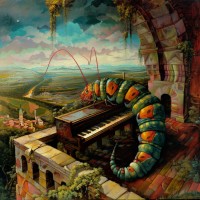
I haven't spent a lot of time on it, it looks like a curious creature, maybe a nice option for folks used to Pianoteq that have only a passing interest in adding an obvious synthesizer sound or two to mainly blend in pads or strings within a tool they are relatively familiar with.
Obviously if you want an accurate model of specific analogue hardware synth Modartt haven't even attempted this - and shouldn't obviously within Pianoteq anyway.

Re: Syngular

Key Fumbler wrote:
DEZ wrote:
daniel_r328 wrote:

Hey DEZ, you seem to know your way around conventional synths so I'm interested in your take: Does Syngular sound like a typical synth to your ears (just with a different parameter abstraction and a built in resonance FX) or does it do something new?

It's nothing like a traditional synth and it's probably not supposed to be. I haven't been able to manipulate the sound once it's in motion so evolving pads in out of the question unless you manipulate the FX section perhaps - not tried that.

Would I buy this and not the latest offering by Cherry Audio - NO !!!

Perhaps it will come into its own when morphing or layering with existing sounds offered within Pianoteq ...

Yes I think it's best to think of it that way - an easy access built-in synth layer/s option, mostly for those using the standalone as a performance instrument, at keys/foot pedals level only. They aren't shooting this one at U-HE customers.

I haven't spent a lot of time on it, it looks like a curious creature, maybe a nice option for folks used to Pianoteq that have only a passing interest in adding an obvious synthesizer sound or two to mainly blend in pads or strings within a tool they are relatively familiar with.
Obviously if you want an accurate model of specific analogue hardware synth Modartt haven't even attempted this - and shouldn't obviously within Pianoteq anyway.

you are right it is a curious creature , and actually a ‘singular’ one;)  I am not up to date with analog synth VSTis being a classical pianist teacher and playing only acoustic pianos and pianoteq but it maybe given that Modartt uses a model made for pianos and are ‘stretching’ the model and the various parameters they end up with unique timbres  that the best in bread available synth VSTis would actually struggle to reproduce as the synthesis behind is different. The new Syngular seems to be designed to create new, imaginary timbres that are detached from the limitations of real-world acoustics, yet retain the organic, dynamic feel and natural velocity response that physical modeling provides. It reminds some acoustic experimentations done by contemporary pianists who introduced special felts and other materials to transform the sound of grand pianos and produce radically different sounds .
In all cases as you say , it’s a really nice addition for gig performers .

Last edited by Pianistically (15-12-2025 20:57)

Re: Syngular

DEZ wrote:

It's nothing like a traditional synth and it's probably not supposed to be.

Exactly! If one wants a traditional synth,then buys a traditional synth. This is different, and frankly I applaud Modartt for it. Just another choice in our sound palette, which you can use if you wish.

Where do I find a list of all posts I upvoted? :(

Re: Syngular

Here is a simple recorder on Singular ...

https://youtu.be/rwk9Jl9PVlU

Re: Syngular

I'm looking forward to all the user made FXPs!

"Very funny, Scotty. Now beam down my clothes."

Re: Syngular

Well I bought it and it will be nice to have.  While Pianoteq is my go to piano, I have quite the synth armada and in comparison, Syngular is pretty sterile sounding.  I believe with some exploration I'll be able to wrangle some movement and interest.  As mentioned by others, I do miss resonance and the ability to animate/modulate the filter for expression.  I play an EVI and I'm not sure Syngular will provide me anything exciting - but then it's not trying to be everything.  Personally I would have loved to see the Syngular sound generation as an oscillator in a more subtractive scenario with an added noise generator, resonance, an additional LFO etc.  But that's not what this is and I get it.

Last edited by Cellomangler (Today 06:37)
"Downing a fifth results in diminished capacity."