This question came up recently in another thread Mystery solved!
Can an internal connected sound engine of a digital piano influence the latency of the external MIDI output??
I could not find specific examples on the internet.
I became curious if I can find such an effect with my old Kawai ES3. At the moment it seems I just found a strong placebo effect
Setting the ES3 to local control off made me feel that for instance Pianoteq's Rhodes (connected via USB-MIDI) is more tight and feels better - hard to describe.
So I tried to verify the acoustic response times with and without local control off (time from key touch noise to speaker sound). Pianoteq 6.6.0 was set to standard Steinway D Prelude.
For example a recorded wave, where the measured timespan is 35 ms between key touch and pianoteq sound:
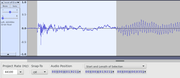
I found no clear evidence for better latency with local-off using a single note C5 on this Kawai.
No matter whether the internal connected ES3-sound was the default Piano or Organ (both volume muted with a switch).
It seems, that the response is a few milliseconds better with local off, but a manual key touch is not easy reproducible and could be the reason (although I tried to hit the note C5 with constant staccato forte several times.
The raw values of a few repetitions:
Pianoteq Steinway D Prelude, key C5
===================================
ES3 Piano, local ON
[ms] latency
35
36
35
36
36
ES3 Piano, local OFF
[ms] latency
31
34
34
34
35
31
-----------------------------------
ES3 Organ, local ON
[ms] latency
36
36
38
39
37
35
36
ES3 Organ, local OFF
[ms] latency
33
35
35
36
36
33
====================================
This experiment is no general statement about keyboards with other internal electronics (of course) or latencies under higher cpu-load (polyphony, dsp-effects etc.).
]]>