<?xml version="1.0" encoding="utf-8"?>
<feed xmlns="http://www.w3.org/2005/Atom">
	<title type="html"><![CDATA[Modartt user forum - Real velocities?]]></title>
	<link rel="self" href="https://forum.modartt.com/extern.php?action=feed&amp;tid=4914&amp;type=atom"/>
	<updated>2017-02-21T02:28:41Z</updated>
	<generator>PunBB</generator>
	<id>https://forum.modartt.com/viewtopic.php?id=4914</id>
		<entry>
			<title type="html"><![CDATA[Re: Real velocities?]]></title>
			<link rel="alternate" href="https://forum.modartt.com/viewtopic.php?pid=946789#p946789"/>
			<content type="html"><![CDATA[<p>Cool idea. I don&#039;t use an S curve, but something similar I guess. I clip the bottom at 20 and the top at a 105, linear in between those two points. Seems to be OK with my YDP-181.</p>]]></content>
			<author>
				<name><![CDATA[bSharpCyclist]]></name>
				<uri>https://forum.modartt.com/profile.php?id=5052</uri>
			</author>
			<updated>2017-02-21T02:28:41Z</updated>
			<id>https://forum.modartt.com/viewtopic.php?pid=946789#p946789</id>
		</entry>
		<entry>
			<title type="html"><![CDATA[Re: Real velocities?]]></title>
			<link rel="alternate" href="https://forum.modartt.com/viewtopic.php?pid=946786#p946786"/>
			<content type="html"><![CDATA[<p>I had to read the message 3 times before I realized the coin had to face down.&nbsp; I kept trying to visualize out how the difference was calculated with a piece of wood across 3 keys and the coin on top.</p>]]></content>
			<author>
				<name><![CDATA[Mossy]]></name>
				<uri>https://forum.modartt.com/profile.php?id=3856</uri>
			</author>
			<updated>2017-02-21T00:30:39Z</updated>
			<id>https://forum.modartt.com/viewtopic.php?pid=946786#p946786</id>
		</entry>
		<entry>
			<title type="html"><![CDATA[Re: Real velocities?]]></title>
			<link rel="alternate" href="https://forum.modartt.com/viewtopic.php?pid=946776#p946776"/>
			<content type="html"><![CDATA[<p>Wow this is really a great idea ! Very smart, indeed.</p>]]></content>
			<author>
				<name><![CDATA[julien]]></name>
				<uri>https://forum.modartt.com/profile.php?id=2</uri>
			</author>
			<updated>2017-02-20T11:07:29Z</updated>
			<id>https://forum.modartt.com/viewtopic.php?pid=946776#p946776</id>
		</entry>
		<entry>
			<title type="html"><![CDATA[Re: Real velocities?]]></title>
			<link rel="alternate" href="https://forum.modartt.com/viewtopic.php?pid=946769#p946769"/>
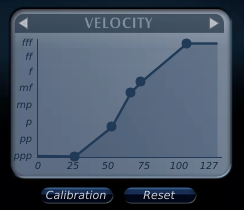
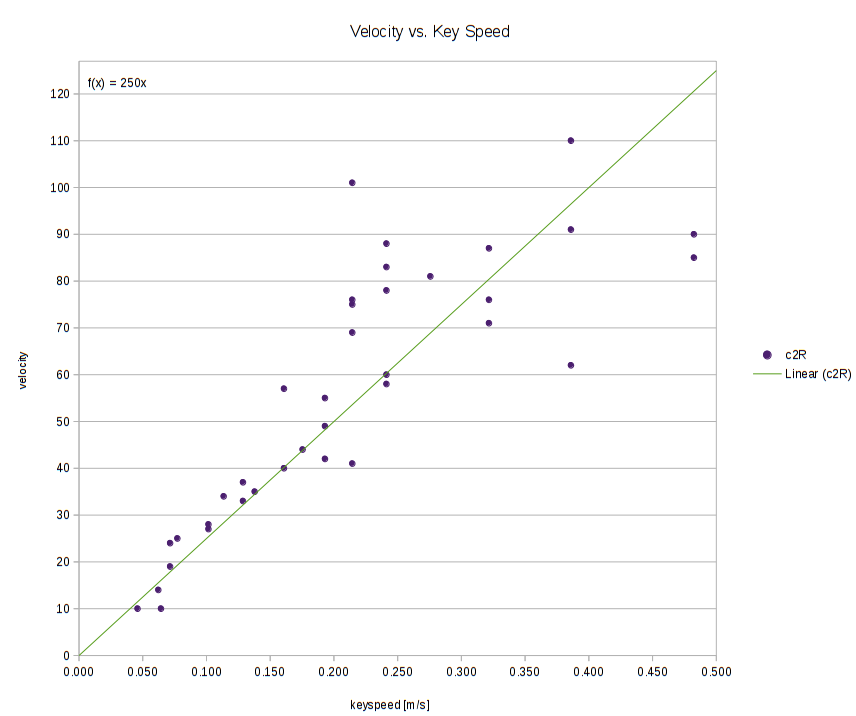
			<content type="html"><![CDATA[<p>... hm, seems to be linear with another key too (here c2):</p><p><span class="postimg"><img src="http://fs5.directupload.net/images/170219/96zrnp7i.png" alt="http://fs5.directupload.net/images/170219/96zrnp7i.png" title="http://fs5.directupload.net/images/170219/96zrnp7i.png"/></span></p><p>If a key would be massless, a linear speed to velocity conversion seems to be a good construction. But a real key has a mass, that has to be accelerated to reach a given velocity. And acceleration against inertia needs a force F=m*a. That could be an explanation, why I use and prefer my s-shaped curve to the default linear velocity mapping:</p><p><span class="postimg"><img src="http://fs5.directupload.net/images/170219/goqwnlpj.png" alt="http://fs5.directupload.net/images/170219/goqwnlpj.png" title="http://fs5.directupload.net/images/170219/goqwnlpj.png"/></span></p><p>Such a shaped curve makes the key virtually &quot;heavier&quot; in the ppp-mp range, where inertia is low, and virtually lighter in the mf-fff range, where F=m*a is stronger. As a result the keyboard response &quot;feels&quot; linearly balanced.</p><p>A question could be, whether an s-shaped curve can be derived/calculated somehow from the measured key-speed function and F=m*a. Any ideas or show-stoppers welcome ...</p>]]></content>
			<author>
				<name><![CDATA[groovy]]></name>
				<uri>https://forum.modartt.com/profile.php?id=1021</uri>
			</author>
			<updated>2017-02-19T23:04:04Z</updated>
			<id>https://forum.modartt.com/viewtopic.php?pid=946769#p946769</id>
		</entry>
		<entry>
			<title type="html"><![CDATA[Real velocities?]]></title>
			<link rel="alternate" href="https://forum.modartt.com/viewtopic.php?pid=946757#p946757"/>
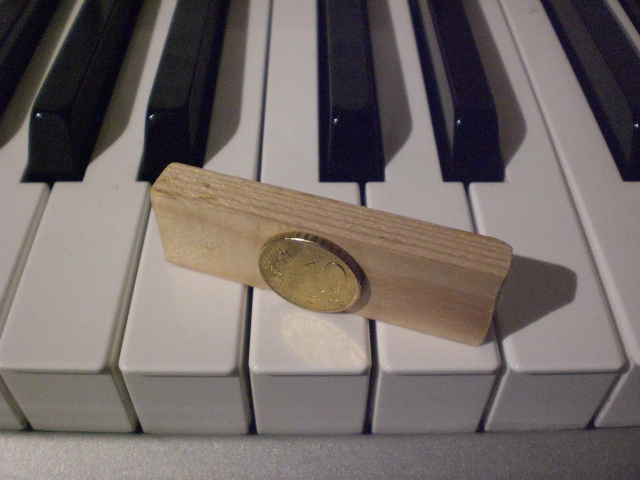
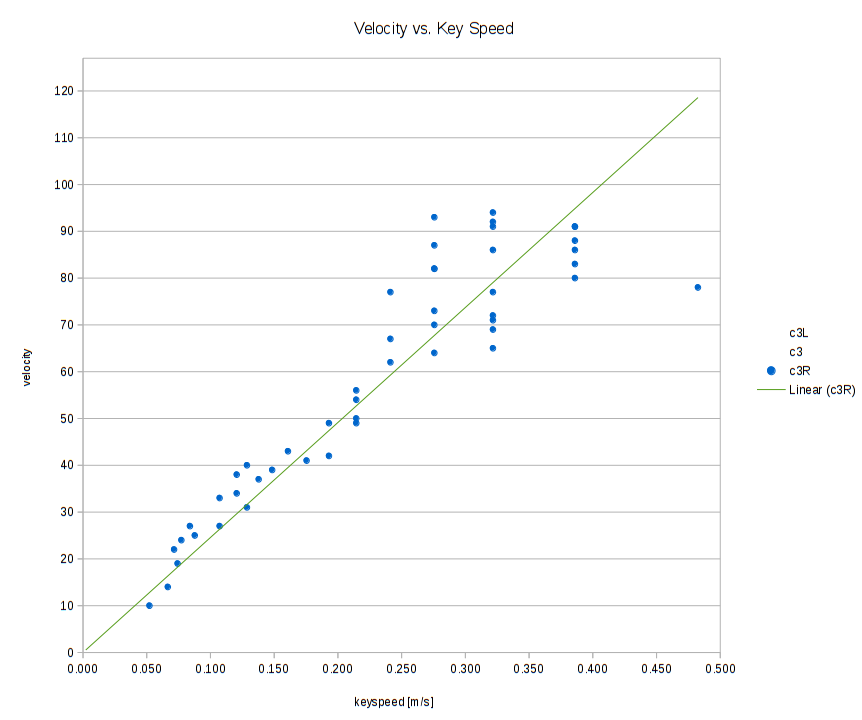
			<content type="html"><![CDATA[<p>Hello,</p><p>I had an idea to estimate the real speed a pressed key has and how it is related to the midi velocity.</p><p>All I needed was a flat piece of wood, a coin and Pianoteq&#039;s midi-eventmonitor.</p><p><span class="postimg"><img src="http://fs5.directupload.net/images/170218/4prxturv.jpg" alt="http://fs5.directupload.net/images/170218/4prxturv.jpg" title="http://fs5.directupload.net/images/170218/4prxturv.jpg"/></span></p><p>With this wooden &quot;tool&quot; I can press three white keys at the same time. Because a ten eurocent coin is 1.93 mm thick, the note-on event of the key below, here c3, happens a little earlier than note-on of d3. The distance of 1.93 mm divided by this eventtime-difference is a rough estimation of the speed of key c3.</p><p>Example:<br />30729 ms Note On C3 veloc: 75<br />30736 ms Note On D3</p><p>ds = 1.93mm<br />dt = 7ms <br />keyspeed = ds/dt = 1.93mm/7ms = 0.276 m/s</p><p>This velocity 75 and keyspeed 0.276 m/s are representing one point in the graph. I set a linear trendline in libreoffice, but many other curves would fit, so I&#039;m not sure it is really a linear relationship in the Kawai. I have to test a few more keys because those rubberbubble-contacts are prone for high tolerances.</p><p><span class="postimg"><img src="http://fs5.directupload.net/images/170218/h26yfcta.png" alt="http://fs5.directupload.net/images/170218/h26yfcta.png" title="http://fs5.directupload.net/images/170218/h26yfcta.png"/></span></p><p>From midi velocity 60 upwards the method is getting unprecisely. The highest resolution in PTQ&#039;s midi-eventmonitor is 1 ms and the faster the keys are pressed, the nearer dt comes to this limit.</p><p>Thanks for your interest</p>]]></content>
			<author>
				<name><![CDATA[groovy]]></name>
				<uri>https://forum.modartt.com/profile.php?id=1021</uri>
			</author>
			<updated>2017-02-18T22:34:01Z</updated>
			<id>https://forum.modartt.com/viewtopic.php?pid=946757#p946757</id>
		</entry>
</feed>