<?xml version="1.0" encoding="utf-8"?>
<feed xmlns="http://www.w3.org/2005/Atom">
	<title type="html"><![CDATA[Modartt user forum - Line out (mono) = (L+R)/2 ?]]></title>
	<link rel="self" href="https://forum.modartt.com/extern.php?action=feed&amp;tid=4752&amp;type=atom"/>
	<updated>2021-01-09T22:51:08Z</updated>
	<generator>PunBB</generator>
	<id>https://forum.modartt.com/viewtopic.php?id=4752</id>
		<entry>
			<title type="html"><![CDATA[Re: Line out (mono) = (L+R)/2 ?]]></title>
			<link rel="alternate" href="https://forum.modartt.com/viewtopic.php?pid=973036#p973036"/>
			<content type="html"><![CDATA[<p>Modartt-Team, thank you one more time for the transparency!</p><p>Change History Pianoteq 7.1.0 (2021/01/08) -&gt;<br />&quot;For instruments where it is applicable, the &#039;mono&#039; and &#039;stereo&#039; outputs can be converted to &#039;sound recording&#039; output (Pianoteq Standard and Pro).&quot;</p><p>The presets &quot;Monophonic&quot; and &quot;Stereophonic&quot; are clear now.</p>]]></content>
			<author>
				<name><![CDATA[groovy]]></name>
				<uri>https://forum.modartt.com/profile.php?id=1021</uri>
			</author>
			<updated>2021-01-09T22:51:08Z</updated>
			<id>https://forum.modartt.com/viewtopic.php?pid=973036#p973036</id>
		</entry>
		<entry>
			<title type="html"><![CDATA[Re: Line out (mono) = (L+R)/2 ?]]></title>
			<link rel="alternate" href="https://forum.modartt.com/viewtopic.php?pid=946112#p946112"/>
			<content type="html"><![CDATA[<p>Thanks.&nbsp; All very helpful.&nbsp; And over-simplified is a good grounding, a good place to start.</p><p>Precise stereo imaging and staging is very difficult to achieve, and now I can see many more reasons for this.&nbsp; Thanks for the contributions to my learning.</p>]]></content>
			<author>
				<name><![CDATA[dklein]]></name>
				<uri>https://forum.modartt.com/profile.php?id=4749</uri>
			</author>
			<updated>2016-12-15T10:16:23Z</updated>
			<id>https://forum.modartt.com/viewtopic.php?pid=946112#p946112</id>
		</entry>
		<entry>
			<title type="html"><![CDATA[Re: Line out (mono) = (L+R)/2 ?]]></title>
			<link rel="alternate" href="https://forum.modartt.com/viewtopic.php?pid=946111#p946111"/>
			<content type="html"><![CDATA[<p>Yes, interesting link, but IMHO a little bit &quot;over-simplified&quot; in many fields...<br />For instance:<br /><a href="https://en.wikipedia.org/wiki/Interaural_time_difference">https://en.wikipedia.org/wiki/Interaura...difference</a><br />or<br /><a href="https://en.wikipedia.org/wiki/Sound_localization">https://en.wikipedia.org/wiki/Sound_localization</a><br />Not so easy to read but more precise... ;-)</p>]]></content>
			<author>
				<name><![CDATA[Luc Henrion]]></name>
				<uri>https://forum.modartt.com/profile.php?id=6</uri>
			</author>
			<updated>2016-12-15T09:29:30Z</updated>
			<id>https://forum.modartt.com/viewtopic.php?pid=946111#p946111</id>
		</entry>
		<entry>
			<title type="html"><![CDATA[Re: Line out (mono) = (L+R)/2 ?]]></title>
			<link rel="alternate" href="https://forum.modartt.com/viewtopic.php?pid=946109#p946109"/>
			<content type="html"><![CDATA[<p>Thank you for this document reference - this is exactly what I have been looking for in one treatise for years: a primer on how human hearing works for direction-finding, etc.&nbsp; I have made a &#039;first pass&#039; through it and will have to digest it in a few sessions.</p><p>Thanks again,</p>]]></content>
			<author>
				<name><![CDATA[dklein]]></name>
				<uri>https://forum.modartt.com/profile.php?id=4749</uri>
			</author>
			<updated>2016-12-15T03:59:40Z</updated>
			<id>https://forum.modartt.com/viewtopic.php?pid=946109#p946109</id>
		</entry>
		<entry>
			<title type="html"><![CDATA[Re: Line out (mono) = (L+R)/2 ?]]></title>
			<link rel="alternate" href="https://forum.modartt.com/viewtopic.php?pid=946102#p946102"/>
			<content type="html"><![CDATA[<div class="quotebox"><cite>dklein wrote:</cite><blockquote><p>So, why is it that the microphone position is so critical but our ear position is not?&nbsp; I cannot remember hearing dramatic timbre differences when I shift my head left or right to see the pianist when standing close to the piano?&nbsp; (Perhaps my stereo hearing and the perceptual engineering circuit reconstructs what it thinks that you should hear.&nbsp; Maybe I should try it with an earplug in one ear to try to reproduce monaural hearing)</p></blockquote></div><p>Our hearing process is indeed quite different from the recording process of microphones:</p><p><a href="http://www.acousticfields.com/binaural-hearing-vs-microphone-hearing/">http://www.acousticfields.com/binaural-...e-hearing/</a></p>]]></content>
			<author>
				<name><![CDATA[Arkanda]]></name>
				<uri>https://forum.modartt.com/profile.php?id=5022</uri>
			</author>
			<updated>2016-12-14T16:50:49Z</updated>
			<id>https://forum.modartt.com/viewtopic.php?pid=946102#p946102</id>
		</entry>
		<entry>
			<title type="html"><![CDATA[Re: Line out (mono) = (L+R)/2 ?]]></title>
			<link rel="alternate" href="https://forum.modartt.com/viewtopic.php?pid=946098#p946098"/>
			<content type="html"><![CDATA[<p>So, why is it that the microphone position is so critical but our ear position is not?&nbsp; I cannot remember hearing dramatic timbre differences when I shift my head left or right to see the pianist when standing close to the piano?&nbsp; (Perhaps my stereo hearing and the perceptual engineering circuit reconstructs what it thinks that you should hear.&nbsp; Maybe I should try it with an earplug in one ear to try to reproduce monaural hearing)</p>]]></content>
			<author>
				<name><![CDATA[dklein]]></name>
				<uri>https://forum.modartt.com/profile.php?id=4749</uri>
			</author>
			<updated>2016-12-14T04:28:48Z</updated>
			<id>https://forum.modartt.com/viewtopic.php?pid=946098#p946098</id>
		</entry>
		<entry>
			<title type="html"><![CDATA[Re: Line out (mono) = (L+R)/2 ?]]></title>
			<link rel="alternate" href="https://forum.modartt.com/viewtopic.php?pid=946096#p946096"/>
			<content type="html"><![CDATA[<div class="quotebox"><cite>Philippe Guillaume wrote:</cite><blockquote><p>Yes, the units are meters, and the graphic was obtained in early development of the radiation model (that is, the origin of coordinates matches Pianoteq).</p></blockquote></div><p>I&#039;m surprised, interesting! <i class="far fa-smile smiley"></i></p><p>Thank you</p>]]></content>
			<author>
				<name><![CDATA[groovy]]></name>
				<uri>https://forum.modartt.com/profile.php?id=1021</uri>
			</author>
			<updated>2016-12-13T22:51:12Z</updated>
			<id>https://forum.modartt.com/viewtopic.php?pid=946096#p946096</id>
		</entry>
		<entry>
			<title type="html"><![CDATA[Re: Line out (mono) = (L+R)/2 ?]]></title>
			<link rel="alternate" href="https://forum.modartt.com/viewtopic.php?pid=946094#p946094"/>
			<content type="html"><![CDATA[<div class="quotebox"><cite>Philippe Guillaume wrote:</cite><blockquote><p>Yes, the units are meters, and the graphic was obtained in early development of the radiation model (that is, the origin of coordinates matches Pianoteq). It represents indeed the true behavior of the model for a specific instrument, though I don&#039;t remember which piano was that (it likely doesn&#039;t exist anymore, something like C1 or C2?).</p></blockquote></div><p>That reminds me - would it be possible to match the physical size/shape of the model to the grand pianos? It looks kinda weird seeing a Steinway D case on all the grand piano models, especially the CP80.</p>]]></content>
			<author>
				<name><![CDATA[lowendtheory]]></name>
				<uri>https://forum.modartt.com/profile.php?id=3379</uri>
			</author>
			<updated>2016-12-13T21:02:41Z</updated>
			<id>https://forum.modartt.com/viewtopic.php?pid=946094#p946094</id>
		</entry>
		<entry>
			<title type="html"><![CDATA[Re: Line out (mono) = (L+R)/2 ?]]></title>
			<link rel="alternate" href="https://forum.modartt.com/viewtopic.php?pid=946093#p946093"/>
			<content type="html"><![CDATA[<div class="quotebox"><cite>groovy wrote:</cite><blockquote><p>Being just an example, it shows a flat (frequency) response at a position x=2.3 and y= 2.0, if I understand it correctly. If the units are meters and the origin of coordinates matches Pianoteq (very unlikely), a mic position at that point would look like this:<br />[...]<br />Are the units of that surface-graphic feet instead of meters or something? Is the z-axis in dB?&nbsp; How is that example related to the soundboard coordinates used in pianoteq?<br />Cheers</p></blockquote></div><p>Yes, the units are meters, and the graphic was obtained in early development of the radiation model (that is, the origin of coordinates matches Pianoteq). It represents indeed the true behavior of the model for a specific instrument, though I don&#039;t remember which piano was that (it likely doesn&#039;t exist anymore, something like C1 or C2?).</p>]]></content>
			<author>
				<name><![CDATA[Philippe Guillaume]]></name>
				<uri>https://forum.modartt.com/profile.php?id=5</uri>
			</author>
			<updated>2016-12-13T19:06:56Z</updated>
			<id>https://forum.modartt.com/viewtopic.php?pid=946093#p946093</id>
		</entry>
		<entry>
			<title type="html"><![CDATA[Re: Line out (mono) = (L+R)/2 ?]]></title>
			<link rel="alternate" href="https://forum.modartt.com/viewtopic.php?pid=946092#p946092"/>
			<content type="html"><![CDATA[<p>Hello Philippe, Groovy, Piet, et al,</p><p>In retrospect, perhaps it was that my Level Compensation was turned on when I answered Mr. Groovy&#039;s original question, that essentially no difference in volume was noted.&nbsp; I did not capture any wave forms to test compare audio signals; I just did a quick sweep of notes with the mouse in both instances.</p><p>Cheers,</p><p>Joe</p>]]></content>
			<author>
				<name><![CDATA[jcfelice88keys]]></name>
				<uri>https://forum.modartt.com/profile.php?id=734</uri>
			</author>
			<updated>2016-12-13T18:03:47Z</updated>
			<id>https://forum.modartt.com/viewtopic.php?pid=946092#p946092</id>
		</entry>
		<entry>
			<title type="html"><![CDATA[Re: Line out (mono) = (L+R)/2 ?]]></title>
			<link rel="alternate" href="https://forum.modartt.com/viewtopic.php?pid=946091#p946091"/>
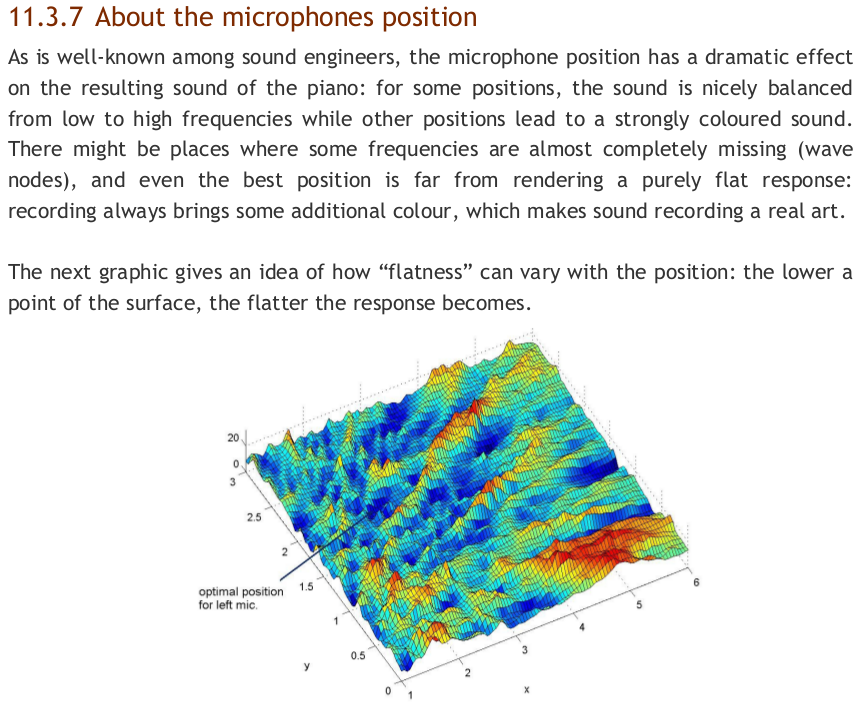
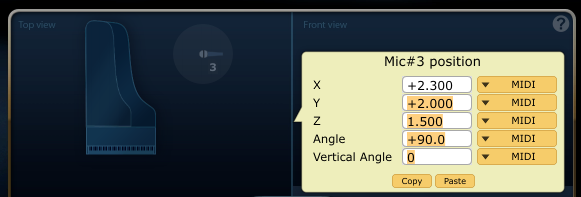
			<content type="html"><![CDATA[<p>Excellent explanation, Philippe, thank you very much!</p><p>So it is all about to find the &quot;sweet spot&quot; with one single mic for each instrument (for native mono). </p><p>Your manual gives an idea, how difficult that can be:</p><p><span class="postimg"><img src="http://fs5.directupload.net/images/161213/mac42v2d.png" alt="http://fs5.directupload.net/images/161213/mac42v2d.png" title="http://fs5.directupload.net/images/161213/mac42v2d.png"/></span></p><p>Being just an example, it shows a flat (frequency) response at a position x=2.3 and y= 2.0, if I understand it correctly. If the units are meters and the origin of coordinates matches Pianoteq (very unlikely), a mic position at that point would look like this:</p><p><span class="postimg"><img src="http://fs5.directupload.net/images/161213/7ryehy8v.png" alt="http://fs5.directupload.net/images/161213/7ryehy8v.png" title="http://fs5.directupload.net/images/161213/7ryehy8v.png"/></span></p><p>Are the units of that surface-graphic feet instead of meters or something? Is the z-axis in dB?&nbsp; How is that example related to the soundboard coordinates used in pianoteq?</p><p>Cheers</p>]]></content>
			<author>
				<name><![CDATA[groovy]]></name>
				<uri>https://forum.modartt.com/profile.php?id=1021</uri>
			</author>
			<updated>2016-12-13T18:03:37Z</updated>
			<id>https://forum.modartt.com/viewtopic.php?pid=946091#p946091</id>
		</entry>
		<entry>
			<title type="html"><![CDATA[Re: Line out (mono) = (L+R)/2 ?]]></title>
			<link rel="alternate" href="https://forum.modartt.com/viewtopic.php?pid=946089#p946089"/>
			<content type="html"><![CDATA[<p>Groovy, your observations are correct. Here is some explanation on how it works and why there are some volume variation on some instruments:<br /></p><ul><li><p>both Monophonic and Sterephonic modes are just a particular configuration of the mics positioning, that is, you can obtain exactly the same result via the OUTPUT section (available in Standard and Pro versions) and chosing the corresponding mic position,</p></li><li><p>usually, the Monophonic output is just the left mic taken from the Stereophonic mode pair,</p></li><li><p>the Monophonic mode is true mono, that is, there is one single mic. That implies that there cannot be phase cancellations isssued from two mics, but still there can be some weak partials (including the fundamental) if the single mic is placed on a node of that partial. You must know that there are numerous nodes all around the piano, so we have to live with,</p></li><li><p>when Monophonic or Sterephonic modes is selected, there is no Level Compensation nor Delay compensation, hence the volume depends on how far the mics are placed from the given instrument, which depends on the selected instrument,</p></li><li><p>for example, in the D4, the Stereophonic pair is placed at [1.50 1.25 1.50; 1.65 0.75 1.50] (let us call it a Close Mic position), hence right in front of the lid, ande the volume is about as loud as in the standard presets,</p></li><li><p>on the contrary, in the Grotrian, the Stereophonic pair is placed at [0.40 -0.60 1.50; 1.10 -0.60 1.50], hence in player position sitting a bit back, hence the reduction in volume,</p></li><li><p>for many years, the Stereophonic pair was placed in Close Mic position (as in D4). Recently (as in Grotrian), we found it more appropriate to have it in player position, which explains what you have observed.</p></li></ul><p>So, that&#039;s the story. It seems that the solution would be to automatically switch the Level Compensation to On when Stereophonic or Monophonic output is selected. We will investigate that for the next version.</p>]]></content>
			<author>
				<name><![CDATA[Philippe Guillaume]]></name>
				<uri>https://forum.modartt.com/profile.php?id=5</uri>
			</author>
			<updated>2016-12-13T07:42:37Z</updated>
			<id>https://forum.modartt.com/viewtopic.php?pid=946089#p946089</id>
		</entry>
		<entry>
			<title type="html"><![CDATA[Re: Line out (mono) = (L+R)/2 ?]]></title>
			<link rel="alternate" href="https://forum.modartt.com/viewtopic.php?pid=946085#p946085"/>
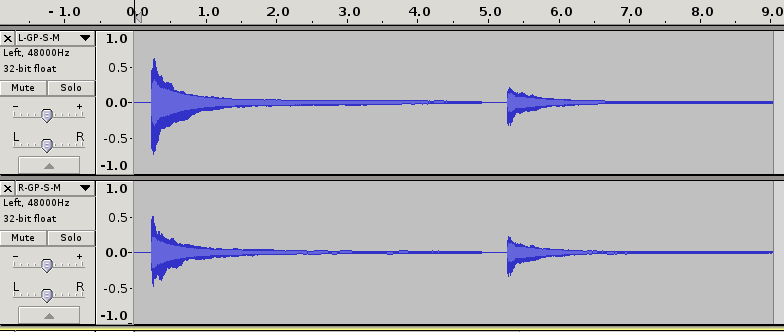
			<content type="html"><![CDATA[<p>@Piet De Ridder<br />Thanks for your confirmation, although I would prefer Joe&#039;s situation. - I&#039;ve tried to quantify the signifcant volume drop when switching from default Sound Recording to Monophonic. First a picture of my raw data. The first track shows the L-Channel of key C3, Sound Recording vs. Monophonic. The second track shows the same with the R-channel. Test-instrument was Grotrian Player (factory default) triggered with velocity 80.</p><p><span class="postimg"><img src="http://fs5.directupload.net/images/161212/7qamco74.png" alt="http://fs5.directupload.net/images/161212/7qamco74.png" title="http://fs5.directupload.net/images/161212/7qamco74.png"/></span></p><p>Trivial observation:<br />- With Monophonic both channels have the same volume. (expected)<br />- With Sound Recording both channels are different (lefthand bass, righthand treble). (expected)</p><p>Unwanted:<br />- The drop of volume when switching to Monophonic is -8.1 dB in the left channel and -4.8 dB in the right channel. For comparison: -6 dB is equivalent to 50% Amplitude.</p><div class="quotebox"><cite>Piet De Ridder wrote:</cite><blockquote><p>Mono-compatibility is, alas, not Pianoteq’s strongest point.</p></blockquote></div><p>Yes, alas. Though I don&#039;t know, if &quot;Mono-compatibility&quot; is the right term. Normally a stereo signal is called mono-compatible, when it does not sound too ugly when mixed to mono aka (L+R)/2. But Pianoteq is a simulation and there is no need to simulate incompatible channels. Is it so difficult to simulate just a single good mono-signal and send it to both channels L and R?? Sorry, for my innocence.</p><br /><br /><p>PS: Technical details<br />Channel L: Volume drop from -17.0 dB to -25.1 dB = -8.1 dB (Average RMS of 1 second pianosound)<br />Channel R: Volume drop from -20.4 dB to -25.1 dB = -4.8 dB (Average RMS of 1 second pianosound)</p>]]></content>
			<author>
				<name><![CDATA[groovy]]></name>
				<uri>https://forum.modartt.com/profile.php?id=1021</uri>
			</author>
			<updated>2016-12-12T22:19:24Z</updated>
			<id>https://forum.modartt.com/viewtopic.php?pid=946085#p946085</id>
		</entry>
		<entry>
			<title type="html"><![CDATA[Re: Line out (mono) = (L+R)/2 ?]]></title>
			<link rel="alternate" href="https://forum.modartt.com/viewtopic.php?pid=946059#p946059"/>
			<content type="html"><![CDATA[<p>My findings are quite different from Joe’s and entirely in line with Groovy’s: when switching the Grotrian (or most other PTQ pianos) from ‘Sound Recording’ to ‘Monophonic’, there *is* indeed a significant (not to say ‘huge’) drop in level and the sound becomes quite weak and ‘hollow’.</p><p>Here are two audio examples (using the Grotrian Prelude preset):</p><p>First, switching from ‘Sound Recording’ to ‘Monophonic’: <a href="http://users.telenet.be/re-peat/PTQStereo/Grotrian_Stereo-Mono_ex1.mp3">example 1</a><br />No need to point out the differences, it seems to me.</p><p>Secondly: switching the stereo output from Pianoteq to mono with a simple stereo&gt;mono audio plugin: <a href="http://users.telenet.be/re-peat/PTQStereo/Grotrian_Stereo-Mono_ex2_monofied.mp3">example 2</a></p><p>Slightly better result, but still not great.</p><p>Actually, the problematic mono-compatibility of Pianoteq instruments — its modelled acoustic pianos in particular — is an issue which comes up quite frequently during beta-testing. Mono-compatibility is, alas, not Pianoteq’s strongest point. It’s got something to do with the way the sound is generated, I suppose; a complex technical matter which I know very little about. Either way, what I do know is that it is very difficult to make Pianoteq produce a mono-signal that sounds as full and ‘complete’ as its stereo-output usually does.<br />Things can be improved somewhat by a judicious adjustment of the microphone parameters, but it isn’t easy and success is not guaranteed.</p><p>Whenever I need Pianoteq to be mono or much more narrow than its default sound — a frequent requirement when doing fuller mixes in which there’s a lot going on —, I *always* do it with external plugins.</p><p>All this to reassure Groovy that there’s nothing wrong with his Pïanoteq installation — the installation itself doesn’t have any bearing on Pianoteq’s sound output anyway — nor that he is in urgent need of a new sound system. The problem which he stumbled upon is wholly intrinsic to the way Pianoteq generates sound.</p><p>_</p>]]></content>
			<author>
				<name><![CDATA[Piet De Ridder]]></name>
				<uri>https://forum.modartt.com/profile.php?id=12</uri>
			</author>
			<updated>2016-12-11T13:41:30Z</updated>
			<id>https://forum.modartt.com/viewtopic.php?pid=946059#p946059</id>
		</entry>
		<entry>
			<title type="html"><![CDATA[Re: Line out (mono) = (L+R)/2 ?]]></title>
			<link rel="alternate" href="https://forum.modartt.com/viewtopic.php?pid=946056#p946056"/>
			<content type="html"><![CDATA[<div class="quotebox"><cite>Luc Henrion wrote:</cite><blockquote><p>Just a guess, but it looks like a phase issue... as if your left and right channels are connected out of phase somewhere.</p></blockquote></div><p>Symptomatically it seems to be in that league, yes, ... but I do not see, where &quot;left and right channels are connected&quot;?</p><p>Phase issues/cancellations can only occur, when two non-identical signals are mixed (for example (L+R)/2). According to a statement in the second post the two signals used in Output-preset &quot;Monophonic&quot; should be identical (&quot;one single mic is sent to the 2 channels&quot;) and no signals are mixed (&quot;there is no sum&quot;).</p><p>Just one very vague idea is, that soundcards or softwares process PCM-data differently, should they be marked mono/1-channel or stereo/2-channel internally at some point. We can see this under other circumstances when a mono-wav (contains one single soundtrack) is played on a PC and automagically is doubled to your left and right PC-speaker.</p>]]></content>
			<author>
				<name><![CDATA[groovy]]></name>
				<uri>https://forum.modartt.com/profile.php?id=1021</uri>
			</author>
			<updated>2016-12-11T11:58:12Z</updated>
			<id>https://forum.modartt.com/viewtopic.php?pid=946056#p946056</id>
		</entry>
</feed>