<?xml version="1.0" encoding="utf-8"?>
<feed xmlns="http://www.w3.org/2005/Atom">
	<title type="html"><![CDATA[Modartt user forum - Mechanical Velocity]]></title>
	<link rel="self" href="https://forum.modartt.com/extern.php?action=feed&amp;tid=4603&amp;type=atom"/>
	<updated>2016-08-10T23:42:22Z</updated>
	<generator>PunBB</generator>
	<id>https://forum.modartt.com/viewtopic.php?id=4603</id>
		<entry>
			<title type="html"><![CDATA[Re: Mechanical Velocity]]></title>
			<link rel="alternate" href="https://forum.modartt.com/viewtopic.php?pid=944088#p944088"/>
			<content type="html"><![CDATA[<p>Some time ago I measured the same thing using a hall sensor and a little magnet, if I find the results I&#039;ll post them here. <br />Anyway I did not measure key speed, but the time elapsed when the key travelled from contact first to second contact.<br />I was not linear, my keyboard is a Kawai Cl35.</p>]]></content>
			<author>
				<name><![CDATA[marcos daniel]]></name>
				<uri>https://forum.modartt.com/profile.php?id=4155</uri>
			</author>
			<updated>2016-08-10T23:42:22Z</updated>
			<id>https://forum.modartt.com/viewtopic.php?pid=944088#p944088</id>
		</entry>
		<entry>
			<title type="html"><![CDATA[Re: Mechanical Velocity]]></title>
			<link rel="alternate" href="https://forum.modartt.com/viewtopic.php?pid=944078#p944078"/>
			<content type="html"><![CDATA[<div class="quotebox"><cite>sigasa wrote:</cite><blockquote><p>Awesome Groovy, very ingenious.</p><p>I wonder if there is anybody who knows what velocity a 50gram weight/100g weight/200g weight etc.. should trigger when placed at front of key and allowed to drop in a consistent manner on a well regulated grand piano??? This would certainly aid any velocity curve creation. Maybe this could best be found out on a hybrid piano, a Yamaha Avant grand for example???</p><p>Kindest Regards,</p><p>Chris</p></blockquote></div><p>+1 for &quot;ingenious&quot; !&nbsp; &nbsp;It lets you _compute_ the physical key velocity, as a function of horizontal wheel velocity.&nbsp; </p><p>a) There&#039;s no industry-standard definition for &quot;well-regulated grand piano&quot;.&nbsp; &nbsp;Manufacturers do things differently, players&#039; tastes differ, and piano techs have different preferences.</p><p>b) You&#039;d have to be careful to measure the velocity _at the moment of releasing the hammer_.&nbsp; Grand piano actions (I think) don&#039;t have constant resistance, as the key goes down.</p><p>c) I&#039;m not saying the experiment isn&#039;t worthwhile.&nbsp; But don&#039;t expect Piano A to give the same results as Piano B.</p><p>.&nbsp; &nbsp; &nbsp;Charles</p>]]></content>
			<author>
				<name><![CDATA[cpcohen]]></name>
				<uri>https://forum.modartt.com/profile.php?id=3575</uri>
			</author>
			<updated>2016-08-09T00:17:15Z</updated>
			<id>https://forum.modartt.com/viewtopic.php?pid=944078#p944078</id>
		</entry>
		<entry>
			<title type="html"><![CDATA[Re: Mechanical Velocity]]></title>
			<link rel="alternate" href="https://forum.modartt.com/viewtopic.php?pid=944060#p944060"/>
			<content type="html"><![CDATA[<p>Awesome Groovy, very ingenious.</p><p>I wonder if there is anybody who knows what velocity a 50gram weight/100g weight/200g weight etc.. should trigger when placed at front of key and allowed to drop in a consistent manner on a well regulated grand piano??? This would certainly aid any velocity curve creation. Maybe this could best be found out on a hybrid piano, a Yamaha Avant grand for example???</p><p>Kindest Regards,</p><p>Chris</p>]]></content>
			<author>
				<name><![CDATA[sigasa]]></name>
				<uri>https://forum.modartt.com/profile.php?id=399</uri>
			</author>
			<updated>2016-08-06T15:24:11Z</updated>
			<id>https://forum.modartt.com/viewtopic.php?pid=944060#p944060</id>
		</entry>
		<entry>
			<title type="html"><![CDATA[Re: Mechanical Velocity]]></title>
			<link rel="alternate" href="https://forum.modartt.com/viewtopic.php?pid=944054#p944054"/>
			<content type="html"><![CDATA[<p>Thank you very much for all those very nice comments! You made my day!</p>]]></content>
			<author>
				<name><![CDATA[groovy]]></name>
				<uri>https://forum.modartt.com/profile.php?id=1021</uri>
			</author>
			<updated>2016-08-05T14:58:36Z</updated>
			<id>https://forum.modartt.com/viewtopic.php?pid=944054#p944054</id>
		</entry>
		<entry>
			<title type="html"><![CDATA[Re: Mechanical Velocity]]></title>
			<link rel="alternate" href="https://forum.modartt.com/viewtopic.php?pid=944053#p944053"/>
			<content type="html"><![CDATA[<p>This is fabulous experimentation. I&#039;m to dumb to say what it will show/prove disprove but I love the idea of a wheel with a known directional velocity (speed travelling up or down a keyboard) and diameter ( and hence some smart bigger will work out what velocity each note is receiving) &quot;playing&quot; the keyboard.</p>]]></content>
			<author>
				<name><![CDATA[rAC]]></name>
				<uri>https://forum.modartt.com/profile.php?id=4771</uri>
			</author>
			<updated>2016-08-05T13:46:46Z</updated>
			<id>https://forum.modartt.com/viewtopic.php?pid=944053#p944053</id>
		</entry>
		<entry>
			<title type="html"><![CDATA[Re: Mechanical Velocity]]></title>
			<link rel="alternate" href="https://forum.modartt.com/viewtopic.php?pid=944049#p944049"/>
			<content type="html"><![CDATA[<div class="quotebox"><cite>groovy wrote:</cite><blockquote><p>I geeked out about velocity again <i class="far fa-smile smiley"></i>. I wanted to know the relation between the &quot;mechanical&quot; speed of my keys and its &quot;electrical&quot; representation known as MIDI-velocity. I don&#039;t know any methods for this and so I re-invented the wheel ...</p></blockquote></div><p>Wow using a wheel is an awesome idea , very impressive !</p>]]></content>
			<author>
				<name><![CDATA[julien]]></name>
				<uri>https://forum.modartt.com/profile.php?id=2</uri>
			</author>
			<updated>2016-08-05T09:32:46Z</updated>
			<id>https://forum.modartt.com/viewtopic.php?pid=944049#p944049</id>
		</entry>
		<entry>
			<title type="html"><![CDATA[Re: Mechanical Velocity]]></title>
			<link rel="alternate" href="https://forum.modartt.com/viewtopic.php?pid=944047#p944047"/>
			<content type="html"><![CDATA[<div class="quotebox"><cite>groovy wrote:</cite><blockquote><p>Hi there,</p><p>I geeked out about velocity again <i class="far fa-smile smiley"></i>. I wanted to know the relation between the &quot;mechanical&quot; speed of my keys and its &quot;electrical&quot; representation known as MIDI-velocity. I don&#039;t know any methods for this and so I re-invented the wheel ...</p><p><span class="postimg"><img src="http://fs5.directupload.net/images/160804/pnuryu68.jpg" alt="http://fs5.directupload.net/images/160804/pnuryu68.jpg" title="http://fs5.directupload.net/images/160804/pnuryu68.jpg"/></span></p><p>Rolled over the keyboard of my Kawai ES3 I got columns of note-on velocity values. Together with note-off for each note and the timespan between those events I tried to calculate the angular speed of the turning wheel at each note-on. Required were the diameter 185 mm an the trigger-points of my keys, that I measured with a ruler to be -9 mm for note-on, -5 mm for note-off, and around -12 mm for key down completely:</p><p><span class="postimg"><img src="http://fs5.directupload.net/images/160804/x4ymwlq4.jpg" alt="http://fs5.directupload.net/images/160804/x4ymwlq4.jpg" title="http://fs5.directupload.net/images/160804/x4ymwlq4.jpg"/></span></p><p>With some trigonometry and the combined values of five roll-overs at different speeds (slow -&gt; medium -&gt; fast) I got a <strong>non-linear</strong> response to the &quot;mechanical&quot; speed of the keys:</p><p><span class="postimg"><img src="http://fs5.directupload.net/images/160804/o2i85irs.png" alt="http://fs5.directupload.net/images/160804/o2i85irs.png" title="http://fs5.directupload.net/images/160804/o2i85irs.png"/></span></p><p>I don&#039;t know, whether <strong>this non-linear response</strong> it typical for the majority of keyboards with rubber-bubble-contacts or just for Kawai models like this ES3 (or if I just did the wrong math). It would be interesting if something is known around this topic.&nbsp; </p><p>Thanks for your attention</p></blockquote></div><p>I guess you could say the subject of MIDI velocity is &quot;touch and go.&quot;&nbsp; I would say what is more important is how musically and expressively you are actually able to play the instrument.&nbsp; The is not way I know of measuring the &quot;velocity&quot; on an acoustic piano.&nbsp; The keys either respond well or they don&#039;t.&nbsp; With electronic instruments, the subtlety of response can be elusive.</p>]]></content>
			<author>
				<name><![CDATA[GRB]]></name>
				<uri>https://forum.modartt.com/profile.php?id=4233</uri>
			</author>
			<updated>2016-08-05T00:55:38Z</updated>
			<id>https://forum.modartt.com/viewtopic.php?pid=944047#p944047</id>
		</entry>
		<entry>
			<title type="html"><![CDATA[Mechanical Velocity]]></title>
			<link rel="alternate" href="https://forum.modartt.com/viewtopic.php?pid=944043#p944043"/>
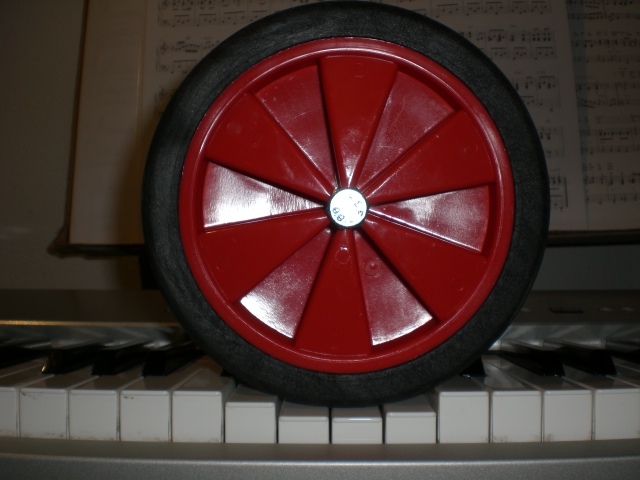
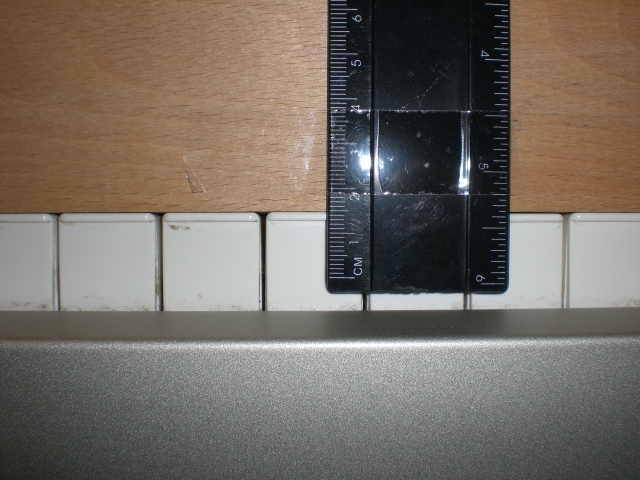
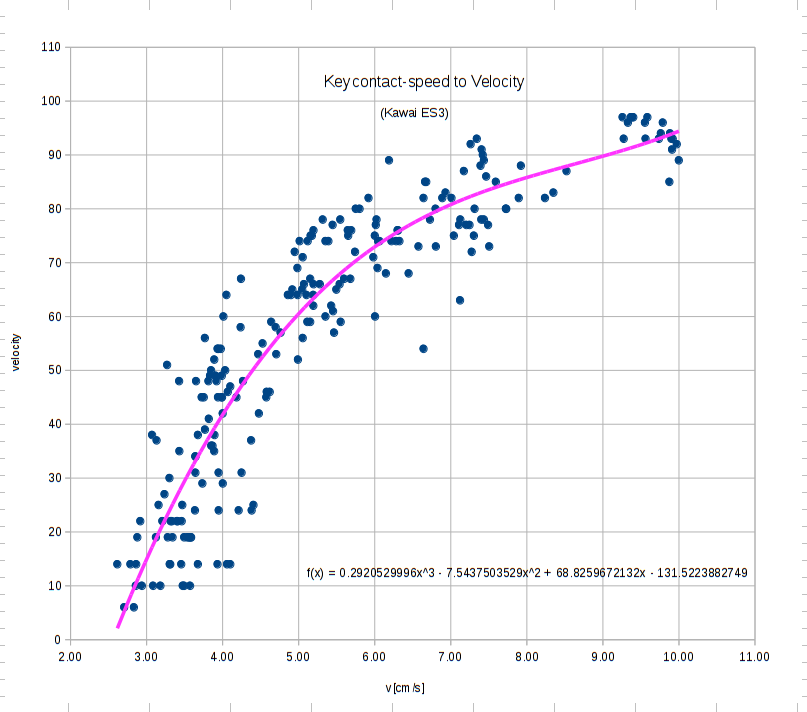
			<content type="html"><![CDATA[<p>Hi there,</p><p>I geeked out about velocity again <i class="far fa-smile smiley"></i>. I wanted to know the relation between the &quot;mechanical&quot; speed of my keys and its &quot;electrical&quot; representation known as MIDI-velocity. I don&#039;t know any methods for this and so I re-invented the wheel ...</p><p><span class="postimg"><img src="http://fs5.directupload.net/images/160804/pnuryu68.jpg" alt="http://fs5.directupload.net/images/160804/pnuryu68.jpg" title="http://fs5.directupload.net/images/160804/pnuryu68.jpg"/></span></p><p>Rolled over the keyboard of my Kawai ES3 I got columns of note-on velocity values. Together with note-off for each note and the timespan between those events I tried to calculate the angular speed of the turning wheel at each note-on. Required were the diameter 185 mm an the trigger-points of my keys, that I measured with a ruler to be -9 mm for note-on, -5 mm for note-off, and around -12 mm for key down completely:</p><p><span class="postimg"><img src="http://fs5.directupload.net/images/160804/x4ymwlq4.jpg" alt="http://fs5.directupload.net/images/160804/x4ymwlq4.jpg" title="http://fs5.directupload.net/images/160804/x4ymwlq4.jpg"/></span></p><p>With some trigonometry and the combined values of five roll-overs at different speeds (slow -&gt; medium -&gt; fast) I got a <strong>non-linear</strong> response to the &quot;mechanical&quot; speed of the keys:</p><p><span class="postimg"><img src="http://fs5.directupload.net/images/160804/o2i85irs.png" alt="http://fs5.directupload.net/images/160804/o2i85irs.png" title="http://fs5.directupload.net/images/160804/o2i85irs.png"/></span></p><p>I don&#039;t know, whether <strong>this non-linear response</strong> it typical for the majority of keyboards with rubber-bubble-contacts or just for Kawai models like this ES3 (or if I just did the wrong math). It would be interesting if something is known around this topic.&nbsp; </p><p>Thanks for your attention</p>]]></content>
			<author>
				<name><![CDATA[groovy]]></name>
				<uri>https://forum.modartt.com/profile.php?id=1021</uri>
			</author>
			<updated>2016-08-04T20:46:41Z</updated>
			<id>https://forum.modartt.com/viewtopic.php?pid=944043#p944043</id>
		</entry>
</feed>