<?xml version="1.0" encoding="utf-8"?>
<feed xmlns="http://www.w3.org/2005/Atom">
	<title type="html"><![CDATA[Modartt user forum - Yamaha CLP-685 velocity curve (measured, method included)]]></title>
	<link rel="self" href="https://forum.modartt.com/extern.php?action=feed&amp;tid=13390&amp;type=atom"/>
	<updated>2026-08-21T07:03:57Z</updated>
	<generator>PunBB</generator>
	<id>https://forum.modartt.com/viewtopic.php?id=13390</id>
		<entry>
			<title type="html"><![CDATA[Yamaha CLP-685 velocity curve (measured, method included)]]></title>
			<link rel="alternate" href="https://forum.modartt.com/viewtopic.php?pid=1009007#p1009007"/>
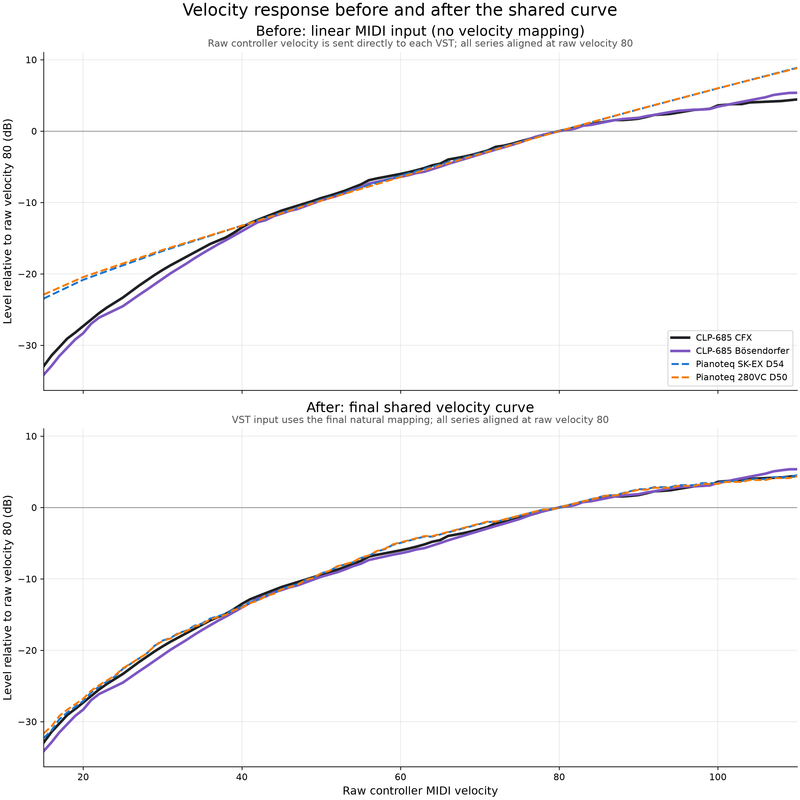
			<content type="html"><![CDATA[<p>I measured the velocity-to-level response of my CLP-685 internal pianos (using its USB audio interface for recording midi+wav into DAW), then used the same MIDI to render Pianoteq and derive a simple remap. The goal was not to make the VST sound identical, but to make the <em>key velocity → loudness</em> response follow the Yamaha factory response more closely. </p><p>Part of the reason was to avoid making the curve artificially easy, then practising a touch that does not transfer well to another instrument or an acoustic piano. I used the Yamaha response as a practical target because I expect its factory tuning to be a safer starting point than simply optimizing for the easiest feel.</p><p>Here is the final curve I am using:</p><div class="codebox"><pre><code>Velocity = [0, 1, 6, 7, 15, 30, 60, 90, 120, 127; 0, 1, 3, 4, 14, 48, 91, 117, 127, 127]</code></pre></div><p>I measured attack level from matched MIDI/audio renders across C2, C3, C4 and C5, fitted each register separately, then compared the pooled response curves. I also ran a dedicated low- and high-velocity sweep before simplifying the curve to the points above.</p><p>With Pianoteq SK-EX at 54 dB Dynamics and 280VC at 50 dB, this curve tracks the CLP CFX and Bösendorfer internal responses closely through the main playable range. The two small low-end points, 6→3 and 7→4, are there because Pianoteq has a large discrete jump between its velocity 3 and 4 layers.</p><p>The plot below shows the result. On the left, the remapped Pianoteq curves closely follow the two internal Yamaha curves. The right panel is only a reminder that bass/treble voicing is a separate issue from the global velocity curve.</p><p><a href="https://postimg.cc/Fd9sFrcL"><span class="postimg"><img src="https://i.postimg.cc/cH3Km6LX/image.png" alt="https://i.postimg.cc/cH3Km6LX/image.png" title="https://i.postimg.cc/cH3Km6LX/image.png"/></span></a></p>]]></content>
			<author>
				<name><![CDATA[yang]]></name>
				<uri>https://forum.modartt.com/profile.php?id=11031</uri>
			</author>
			<updated>2026-08-21T07:03:57Z</updated>
			<id>https://forum.modartt.com/viewtopic.php?pid=1009007#p1009007</id>
		</entry>
</feed>