<?xml version="1.0" encoding="utf-8"?>
<feed xmlns="http://www.w3.org/2005/Atom">
	<title type="html"><![CDATA[Modartt user forum - Vidal MIDI piano controller--user review]]></title>
	<link rel="self" href="https://forum.modartt.com/extern.php?action=feed&amp;tid=12477&amp;type=atom"/>
	<updated>2026-04-11T12:41:37Z</updated>
	<generator>PunBB</generator>
	<id>https://forum.modartt.com/viewtopic.php?id=12477</id>
		<entry>
			<title type="html"><![CDATA[Re: Vidal MIDI piano controller--user review]]></title>
			<link rel="alternate" href="https://forum.modartt.com/viewtopic.php?pid=1007571#p1007571"/>
			<content type="html"><![CDATA[<div class="quotebox"><cite>Stephen_Doonan wrote:</cite><blockquote><div class="quotebox"><cite>Pianistically wrote:</cite><blockquote><p>[Excellent review. Regarding the pedal, I assume you know that the audiofront pedal adapter supports the Kawai optical pedal GFP3 which is way better than the Studiologic SP3D which is more or less the same FATAR pedal&nbsp; F-30 found in the VPC1 that many users have complained about.&nbsp; Your Vidal keyboard deserves it !</p></blockquote></div><p>Just curious. The Kawai GFP-3 triple pedal has an unusual 6-pin connector. Is that compatible with any Audiofront.net product?</p></blockquote></div><p> good point . I should have mentioned that . There is bit of easy DYI to perform. You need to&nbsp; buy a 6 pin female socket &amp; 3&nbsp; 1/4” trs male sockets and rewire .The internal wiring is widely available.&nbsp; For instance here </p><p><a href="https://github.com/madmatah/ATMPedal/blob/main/receipes/kawai_grand_feed_pedals/README.md">https://github.com/madmatah/ATMPedal/bl.../README.md</a></p><p>Other alternative is to buy 3 separate F10H&nbsp; optical pedals from Kawai and wire them directly into the audiofront device but I prefer the GFP3 model as it is really heavy and doesn’t move at all . It’s an amazing pedal , no noise and last forever with consistent midi output and high precision for half pedalling work .</p>]]></content>
			<author>
				<name><![CDATA[Pianistically]]></name>
				<uri>https://forum.modartt.com/profile.php?id=9183</uri>
			</author>
			<updated>2026-04-11T12:41:37Z</updated>
			<id>https://forum.modartt.com/viewtopic.php?pid=1007571#p1007571</id>
		</entry>
		<entry>
			<title type="html"><![CDATA[Re: Vidal MIDI piano controller--user review]]></title>
			<link rel="alternate" href="https://forum.modartt.com/viewtopic.php?pid=1007565#p1007565"/>
			<content type="html"><![CDATA[<div class="quotebox"><cite>Pianistically wrote:</cite><blockquote><p>[Excellent review. Regarding the pedal, I assume you know that the audiofront pedal adapter supports the Kawai optical pedal GFP3 which is way better than the Studiologic SP3D which is more or less the same FATAR pedal&nbsp; F-30 found in the VPC1 that many users have complained about.&nbsp; Your Vidal keyboard deserves it !</p></blockquote></div><p>Just curious. The Kawai GFP-3 triple pedal has an unusual 6-pin connector. Is that compatible with any Audiofront.net product?</p>]]></content>
			<author>
				<name><![CDATA[Stephen_Doonan]]></name>
				<uri>https://forum.modartt.com/profile.php?id=4838</uri>
			</author>
			<updated>2026-04-10T23:18:20Z</updated>
			<id>https://forum.modartt.com/viewtopic.php?pid=1007565#p1007565</id>
		</entry>
		<entry>
			<title type="html"><![CDATA[Re: Vidal MIDI piano controller--user review]]></title>
			<link rel="alternate" href="https://forum.modartt.com/viewtopic.php?pid=1007564#p1007564"/>
			<content type="html"><![CDATA[<div class="quotebox"><cite>smulloni wrote:</cite><blockquote><p>Here are my thoughts on the Vidal, which I’ve had since late November. </p><p>There was a problem with my shipment— FedEx made a mistake and misclassified it as freight or something, and sadly it arrived somewhat damaged. On a day right before a holiday, Vidal owner Tom Rudnitsky drove up to where I am, 2 hours away, to replace the lid, which was cracked, and make sure it was OK. This was an awfully nice thing to do. A lot of good will, experience, intelligence, passion and soul go into the creation of the Vidal, and it shows. It is also built like a tank, and it survived the fall it evidently had experienced very well.</p><p>As is obvious from photos, the Vidal is gorgeous; in terms of beauty, craftsmanship, and the human touch, there is nothing else like it in this realm — on these terms it reigns supreme. Its design is radically transparent. You can open it up to get at the action — long wooden levers, like a clavichord’s, but with heftier counterweights — simply by lifting the lid. It’s an instrument you can easily feel physically connected to, and that’s a rare trait for electronic gear, especially a MIDI controller. </p><p>I think it’s important, however, to distinguish between the aesthetic and, one might say, spiritual virtues of the Vidal from some other pragmatic considerations.</p><p>First, in my case, a minor matter: despite all the care that Tom took with it, perhaps because&nbsp; it had been banged up a bit in shipping, as I began to use it, I soon discovered that the action made a variety of unwelcome noises due to friction between parts or other factors. Tom advised me how to fix some of them. A few which I lazily haven’t reported to him I have lived with, though I should address them at some point, and I’m sure Tom would help. None of them are functionally important, though — were they, I’d have stopped everything and dealt with them. I wonder whether the increased weight of the action, and the fact that it is made from wood, may come to involve more service or intervention to prevent these issues. (On the other hand, the action is so simple that it may be resistant to serious problems.)</p><p>More importantly, perhaps: several users have said that the Vidal feels just like a real piano, or more so than other controllers. I have to say that I don’t really agree with this. I go back and forth between it and a Steinway M, and the difference is significant to me. The action works on quite a different principle: as mentioned above, the Vidal’s is like a clavichord’s, essentially a simple lever, but unlike a clavichord, whose motion stops when a tangent at the far end of the lever hits a string, here the bottom of the key hits a force-absorbing barrier. At this point, there is a sort of thud which initially I found to feel somewhat abrupt. At first this made me feel hesitant to play loud, thick textures (though another attribute of the Vidal helps with this: it is heavy and, unlike lighter controllers, doesn’t shake when you throw yourself at it), and the noise of the action encouraged this reluctance. However, I’ve adjusted to this, and on the positive side, the action has a very nice toothiness, the aspect most reminiscent of a well-regulated grand action (and one where many controllers fall short), and is entirely without mushiness, which is more than can be said even of many acoustic instruments, so it lends itself very well to rhythmically and dynamically precise playing. </p><p>Ultimately, a controller of this kind, though a cousin to an acoustic piano, simply is not one, and it doesn’t need to feel exactly the same as long as players can do what they need with it and go back and forth between it and other pianos without undue difficulty. Acoustic pianos also feel very different from one another. In addition, what a piano feels like is a very subjective mixture of what the piano is, and how a particular person approaches it and interacts with it. </p><p>I have not been able to do side-by-side comparisons with my previous controller, a Kawai MP11SE, or with the various hybrid instruments now available from Kawai and Yamaha. I prefer this action to the Kawai’s, which had for me something of a “there is no there there” feeling, whereas the Vidal has a pleasurable sense of bite, with excellent haptic feedback.&nbsp; But I can’t honestly say that the Vidal enables me in practical terms to do something I couldn’t do with the Kawai, which in the end was controllable and reliable. Still, there is more to life and art than practicality, and I certainly don’t regret having such a beautiful, and beautifully conceived and made, instrument as an essential part of my daily regimen. It was worth it for me.</p><p>One clear, but small, deficit: the supported Studiologic pedal is less good than the Kawai pedal. I hope that an update will make other triple-unit pedals directly supported. If not, there are workarounds, and the Studiologic model is usable.</p><p>I would not urge the Vidal on prospective buyers on the basis that it would solve fundamental problems they have with playing MIDI controllers, just as I would not suggest that wearing an exquisitely hand-tailored outfit would keep you warmer in the winter. But I would recommend it to anyone for whom the price tag is not an obstacle who would appreciate and benefit from having such a graceful and well-thought-out instrument as a musical companion.</p></blockquote></div><p> Excellent review. Regarding the pedal, I assume you know that the audiofront pedal adapter supports the Kawai optical pedal GFP3 which is way better than the Studiologic SP3D which is more or less the same FATAR pedal&nbsp; F-30 found in the VPC1 that many users have complained about.&nbsp; Your Vidal keyboard deserves it !</p>]]></content>
			<author>
				<name><![CDATA[Pianistically]]></name>
				<uri>https://forum.modartt.com/profile.php?id=9183</uri>
			</author>
			<updated>2026-04-10T22:28:03Z</updated>
			<id>https://forum.modartt.com/viewtopic.php?pid=1007564#p1007564</id>
		</entry>
		<entry>
			<title type="html"><![CDATA[Re: Vidal MIDI piano controller--user review]]></title>
			<link rel="alternate" href="https://forum.modartt.com/viewtopic.php?pid=1007554#p1007554"/>
			<content type="html"><![CDATA[<p>Here are my thoughts on the Vidal, which I’ve had since late November. </p><p>There was a problem with my shipment— FedEx made a mistake and misclassified it as freight or something, and sadly it arrived somewhat damaged. On a day right before a holiday, Vidal owner Tom Rudnitsky drove up to where I am, 2 hours away, to replace the lid, which was cracked, and make sure it was OK. This was an awfully nice thing to do. A lot of good will, experience, intelligence, passion and soul go into the creation of the Vidal, and it shows. It is also built like a tank, and it survived the fall it evidently had experienced very well.</p><p>As is obvious from photos, the Vidal is gorgeous; in terms of beauty, craftsmanship, and the human touch, there is nothing else like it in this realm — on these terms it reigns supreme. Its design is radically transparent. You can open it up to get at the action — long wooden levers, like a clavichord’s, but with heftier counterweights — simply by lifting the lid. It’s an instrument you can easily feel physically connected to, and that’s a rare trait for electronic gear, especially a MIDI controller. </p><p>I think it’s important, however, to distinguish between the aesthetic and, one might say, spiritual virtues of the Vidal from some other pragmatic considerations.</p><p>First, in my case, a minor matter: despite all the care that Tom took with it, perhaps because&nbsp; it had been banged up a bit in shipping, as I began to use it, I soon discovered that the action made a variety of unwelcome noises due to friction between parts or other factors. Tom advised me how to fix some of them. A few which I lazily haven’t reported to him I have lived with, though I should address them at some point, and I’m sure Tom would help. None of them are functionally important, though — were they, I’d have stopped everything and dealt with them. I wonder whether the increased weight of the action, and the fact that it is made from wood, may come to involve more service or intervention to prevent these issues. (On the other hand, the action is so simple that it may be resistant to serious problems.)</p><p>More importantly, perhaps: several users have said that the Vidal feels just like a real piano, or more so than other controllers. I have to say that I don’t really agree with this. I go back and forth between it and a Steinway M, and the difference is significant to me. The action works on quite a different principle: as mentioned above, the Vidal’s is like a clavichord’s, essentially a simple lever, but unlike a clavichord, whose motion stops when a tangent at the far end of the lever hits a string, here the bottom of the key hits a force-absorbing barrier. At this point, there is a sort of thud which initially I found to feel somewhat abrupt. At first this made me feel hesitant to play loud, thick textures (though another attribute of the Vidal helps with this: it is heavy and, unlike lighter controllers, doesn’t shake when you throw yourself at it), and the noise of the action encouraged this reluctance. However, I’ve adjusted to this, and on the positive side, the action has a very nice toothiness, the aspect most reminiscent of a well-regulated grand action (and one where many controllers fall short), and is entirely without mushiness, which is more than can be said even of many acoustic instruments, so it lends itself very well to rhythmically and dynamically precise playing. </p><p>Ultimately, a controller of this kind, though a cousin to an acoustic piano, simply is not one, and it doesn’t need to feel exactly the same as long as players can do what they need with it and go back and forth between it and other pianos without undue difficulty. Acoustic pianos also feel very different from one another. In addition, what a piano feels like is a very subjective mixture of what the piano is, and how a particular person approaches it and interacts with it. </p><p>I have not been able to do side-by-side comparisons with my previous controller, a Kawai MP11SE, or with the various hybrid instruments now available from Kawai and Yamaha. I prefer this action to the Kawai’s, which had for me something of a “there is no there there” feeling, whereas the Vidal has a pleasurable sense of bite, with excellent haptic feedback.&nbsp; But I can’t honestly say that the Vidal enables me in practical terms to do something I couldn’t do with the Kawai, which in the end was controllable and reliable. Still, there is more to life and art than practicality, and I certainly don’t regret having such a beautiful, and beautifully conceived and made, instrument as an essential part of my daily regimen. It was worth it for me.</p><p>One clear, but small, deficit: the supported Studiologic pedal is less good than the Kawai pedal. I hope that an update will make other triple-unit pedals directly supported. If not, there are workarounds, and the Studiologic model is usable.</p><p>I would not urge the Vidal on prospective buyers on the basis that it would solve fundamental problems they have with playing MIDI controllers, just as I would not suggest that wearing an exquisitely hand-tailored outfit would keep you warmer in the winter. But I would recommend it to anyone for whom the price tag is not an obstacle who would appreciate and benefit from having such a graceful and well-thought-out instrument as a musical companion.</p>]]></content>
			<author>
				<name><![CDATA[smulloni]]></name>
				<uri>https://forum.modartt.com/profile.php?id=2463</uri>
			</author>
			<updated>2026-04-09T23:34:32Z</updated>
			<id>https://forum.modartt.com/viewtopic.php?pid=1007554#p1007554</id>
		</entry>
		<entry>
			<title type="html"><![CDATA[Re: Vidal MIDI piano controller--user review]]></title>
			<link rel="alternate" href="https://forum.modartt.com/viewtopic.php?pid=1007553#p1007553"/>
			<content type="html"><![CDATA[<div class="quotebox"><cite>EvilDragon wrote:</cite><blockquote><p>A very interesting controller, but all that cost and no support for the absolute best pedal unit on the market (Roland RPU-3) is flabbergasting.</p></blockquote></div><p>Good to see you back!</p>]]></content>
			<author>
				<name><![CDATA[sigasa]]></name>
				<uri>https://forum.modartt.com/profile.php?id=399</uri>
			</author>
			<updated>2026-04-09T22:38:32Z</updated>
			<id>https://forum.modartt.com/viewtopic.php?pid=1007553#p1007553</id>
		</entry>
		<entry>
			<title type="html"><![CDATA[Re: Vidal MIDI piano controller--user review]]></title>
			<link rel="alternate" href="https://forum.modartt.com/viewtopic.php?pid=1007552#p1007552"/>
			<content type="html"><![CDATA[<div class="quotebox"><cite>EvilDragon wrote:</cite><blockquote><div class="quotebox"><cite>Pianophile wrote:</cite><blockquote><p>Note to developers: it would be great if Pianoteq included presents with a dynamic range of 47-50 dB. You could call them &#039;Shigeru Ryuyo Dynamic&#039; et cetera -- or something similar.</p></blockquote></div><p>You can set the Dynamics slider to your wanted value then freeze it so that it&#039;s not changed by any preset you might load. That&#039;s a better solution <i class="far fa-smile smiley"></i></p></blockquote></div><p>Well, kind of. Different Pianoteq presets have different dynamic ranges, for good reasons. The 30 dB of the Shigeru Kawai SK-EX Mix works well for pop music but not for classical. I see a large dynamic range of up to 50 dB as necessary for serious classical playing, since this requires a realistic piano feel. But it isn&#039;t practical for all musical contexts, or for all instrument types in Pianoteq. Since I play mostly classical these days, freezing the dynamic range is indeed pretty handy in my case, but I&#039;d still have to unfreeze occasionally.</p>]]></content>
			<author>
				<name><![CDATA[Pianophile]]></name>
				<uri>https://forum.modartt.com/profile.php?id=95</uri>
			</author>
			<updated>2026-04-09T15:24:17Z</updated>
			<id>https://forum.modartt.com/viewtopic.php?pid=1007552#p1007552</id>
		</entry>
		<entry>
			<title type="html"><![CDATA[Re: Vidal MIDI piano controller--user review]]></title>
			<link rel="alternate" href="https://forum.modartt.com/viewtopic.php?pid=1007547#p1007547"/>
			<content type="html"><![CDATA[<div class="quotebox"><cite>EvilDragon wrote:</cite><blockquote><div class="quotebox"><cite>Stephen_Doonan wrote:</cite><blockquote><p>I think that if I were to use the Roland RPU-3 triple pedal unit, I might use it with the AudioFront.net MIDI Expression iO pedal-to-MIDI hub, as a computer MIDI input device separate from the Vidal. That would be one way to use it with the Vidal. But yes, it would have been a nice consideration for the Vidal.</p></blockquote></div><p>Yeah, more things to buy after you splurge 6.5k on a damn controller. Thanks but no thanks <i class="far fa-grin-tongue-squint smiley"></i></p></blockquote></div><p>Yeah, good point. <i class="far fa-smile smiley"></i> The MIDI pedal controller has been handy though ever since I bought it for the three Yamaha FC7 pedals I have.</p>]]></content>
			<author>
				<name><![CDATA[Stephen_Doonan]]></name>
				<uri>https://forum.modartt.com/profile.php?id=4838</uri>
			</author>
			<updated>2026-04-08T12:17:04Z</updated>
			<id>https://forum.modartt.com/viewtopic.php?pid=1007547#p1007547</id>
		</entry>
		<entry>
			<title type="html"><![CDATA[Re: Vidal MIDI piano controller--user review]]></title>
			<link rel="alternate" href="https://forum.modartt.com/viewtopic.php?pid=1007543#p1007543"/>
			<content type="html"><![CDATA[<div class="quotebox"><cite>Pianophile wrote:</cite><blockquote><p>Note to developers: it would be great if Pianoteq included presents with a dynamic range of 47-50 dB. You could call them &#039;Shigeru Ryuyo Dynamic&#039; et cetera -- or something similar.</p></blockquote></div><p>You can set the Dynamics slider to your wanted value then freeze it so that it&#039;s not changed by any preset you might load. That&#039;s a better solution <i class="far fa-smile smiley"></i></p><div class="quotebox"><cite>Stephen_Doonan wrote:</cite><blockquote><p>I think that if I were to use the Roland RPU-3 triple pedal unit, I might use it with the AudioFront.net MIDI Expression iO pedal-to-MIDI hub, as a computer MIDI input device separate from the Vidal. That would be one way to use it with the Vidal. But yes, it would have been a nice consideration for the Vidal.</p></blockquote></div><p>Yeah, more things to buy after you splurge 6.5k on a damn controller. Thanks but no thanks <i class="far fa-grin-tongue-squint smiley"></i></p>]]></content>
			<author>
				<name><![CDATA[EvilDragon]]></name>
				<uri>https://forum.modartt.com/profile.php?id=618</uri>
			</author>
			<updated>2026-04-08T00:19:30Z</updated>
			<id>https://forum.modartt.com/viewtopic.php?pid=1007543#p1007543</id>
		</entry>
		<entry>
			<title type="html"><![CDATA[Re: Vidal MIDI piano controller--user review]]></title>
			<link rel="alternate" href="https://forum.modartt.com/viewtopic.php?pid=1007538#p1007538"/>
			<content type="html"><![CDATA[<div class="quotebox"><cite>TimN wrote:</cite><blockquote><p>If I set the Pianoteq dynamics setting at about 50dB (default is 40), it honestly feels like a live piano to me, if the output volume in headphones or speakers is set to a real level.</p></blockquote></div><p>I&#039;ve found that this is crucial for getting a good piano feel in Pianoteq, with proper differentiation between different shades of pianissimo and fortissimo. Playing Pianoteq through my NU1XA with a dynamic range of 47-50 dB works brilliantly well. It changes the timbre for pianissimo passages in a really nice way. With the default range of 40 dB, very quiet notes can sound a bit muddy, probably because there&#039;s less dynamic differentation or nuance available. With a higher dynamic range, they sound lighter and airier, like they do on my Grotrian Steinweg grand piano, and the overall sound becomes more transparent. You do need good, powerful speakers, though, that can comfortably accommodate such a high dynamic range.</p><p>Note to developers: it would be great if Pianoteq included presents with a dynamic range of 47-50 dB. You could call them &#039;Shigeru Ryuyo Dynamic&#039; et cetera -- or something similar.</p>]]></content>
			<author>
				<name><![CDATA[Pianophile]]></name>
				<uri>https://forum.modartt.com/profile.php?id=95</uri>
			</author>
			<updated>2026-04-07T18:25:51Z</updated>
			<id>https://forum.modartt.com/viewtopic.php?pid=1007538#p1007538</id>
		</entry>
		<entry>
			<title type="html"><![CDATA[Re: Vidal MIDI piano controller--user review]]></title>
			<link rel="alternate" href="https://forum.modartt.com/viewtopic.php?pid=1007536#p1007536"/>
			<content type="html"><![CDATA[<div class="quotebox"><cite>EvilDragon wrote:</cite><blockquote><p>A very interesting controller, but all that cost and no support for the absolute best pedal unit on the market (Roland RPU-3) is flabbergasting.</p></blockquote></div><p>Yeah, that&#039;s a good point. The Nord TP1 and Studiologic SLP3-D both use a single 1/4&quot; tip-ring-sleeve (TRS) connector, with the sustain (damper) pedal being a continuous controller (via potentiometer), and the other two pedals simple on/off switches. The Roland RPU-3 and the Nord TP2 use potentiometers for all three pedals; the connector for the Nord TP2 looks like a somewhat nonstandard 6 pin connector, while the Roland RPU-3 uses 3 separate 1/4&quot; TRS connectors.</p><p>I think that if I were to use the Roland RPU-3 triple pedal unit, I might use it with the AudioFront.net MIDI Expression iO pedal-to-MIDI hub, as a computer MIDI input device separate from the Vidal. That would be one way to use it with the Vidal. But yes, it would have been a nice consideration for the Vidal.</p>]]></content>
			<author>
				<name><![CDATA[Stephen_Doonan]]></name>
				<uri>https://forum.modartt.com/profile.php?id=4838</uri>
			</author>
			<updated>2026-04-07T16:07:15Z</updated>
			<id>https://forum.modartt.com/viewtopic.php?pid=1007536#p1007536</id>
		</entry>
		<entry>
			<title type="html"><![CDATA[Re: Vidal MIDI piano controller--user review]]></title>
			<link rel="alternate" href="https://forum.modartt.com/viewtopic.php?pid=1007535#p1007535"/>
			<content type="html"><![CDATA[<p>A very interesting controller, but all that cost and no support for the absolute best pedal unit on the market (Roland RPU-3) is flabbergasting.</p>]]></content>
			<author>
				<name><![CDATA[EvilDragon]]></name>
				<uri>https://forum.modartt.com/profile.php?id=618</uri>
			</author>
			<updated>2026-04-07T14:58:48Z</updated>
			<id>https://forum.modartt.com/viewtopic.php?pid=1007535#p1007535</id>
		</entry>
		<entry>
			<title type="html"><![CDATA[Re: Vidal MIDI piano controller--user review]]></title>
			<link rel="alternate" href="https://forum.modartt.com/viewtopic.php?pid=1007513#p1007513"/>
			<content type="html"><![CDATA[<p>I suggest to take Pianoteq&#039;s midi monitor instead of velocitester to countercheck the midi velocity.<br />Without real data of ca. 10 drop repetitions with your ~500 g on key c4 it is hard to guess anything.</p><p>I like the aesthetics of your setup by the way ...</p>]]></content>
			<author>
				<name><![CDATA[groovy]]></name>
				<uri>https://forum.modartt.com/profile.php?id=1021</uri>
			</author>
			<updated>2026-04-05T23:33:39Z</updated>
			<id>https://forum.modartt.com/viewtopic.php?pid=1007513#p1007513</id>
		</entry>
		<entry>
			<title type="html"><![CDATA[Re: Vidal MIDI piano controller--user review]]></title>
			<link rel="alternate" href="https://forum.modartt.com/viewtopic.php?pid=1007512#p1007512"/>
			<content type="html"><![CDATA[<div class="quotebox"><cite>groovy wrote:</cite><blockquote><p>An experiment, that has another outcome than expected, mmh.<br />Did you always place the weight at the same position on the white key of the Vidal?<br />See the image of an old thread, where a piece of paper represents the position at the front of a white key:<br />...</p><p>Did you use the default/normal/power-on velocity curve of the Vidal?</p><p>It needs some practise to set the weight free, yes. Is the variation of a ten times repetition with key c4 and ~ 500 g on the Vidal really so &quot;wide&quot; as you implicated??</p><p>Thanks for your efforts.</p></blockquote></div><p>Yes, I placed the weight as carefully as I could at the same location, at the front of the key, as in the photo below. The Vidal has only one setting for MIDI velocity. That is, there is no way to configure or change the Vidal&#039;s default MIDI velocity-response setting or curve. It was surprising to me that the Vidal transmits a full range of MIDI velocities, from 0 to 127 (but divided into over 16,000 increments, high-resolution MIDI velocity standard using a MIDI CC 88) , with the lightest to heaviest touch on a key. All other MIDI keyboard controllers or digital pianos I&#039;ve owned had a rather strong bias, usually toward the mid to high values, and it was difficult to reliably produce the range of the lowest third or so of MIDI velocities. In this regard the Vidal is superior to all other MIDI controllers/pianos I&#039;ve used (and been able to monitor the MIDI values of).</p><p>I&#039;m not sure why I was not able to reliably produce just a small variation in MIDI-velocity-values at Velocitest.com, when testing the keys one key at a time. The Vidal sends high-resolution MIDI velocity, which instead of 0 to 127, provides a velocity range of 0 to16,256 (or more). I wonder if there is a possibility that might have skewed the results at Velocitest.com.</p><p>To me, the measurements at velocitest.com seemed odd, in comparison with how smooth and seemingly linear the Vidal&#039;s MIDI velocity-values were/are when playing the instrument. I&#039;ll try to do the test again, and to make a video of it, or if I can&#039;t do that, then at least a screenshot of the measurements at velocitest.com.</p><p><span class="postimg"><img src="https://i.imgur.com/X5NjEHP.jpeg" alt="https://i.imgur.com/X5NjEHP.jpeg" title="https://i.imgur.com/X5NjEHP.jpeg"/></span></p>]]></content>
			<author>
				<name><![CDATA[Stephen_Doonan]]></name>
				<uri>https://forum.modartt.com/profile.php?id=4838</uri>
			</author>
			<updated>2026-04-05T23:08:33Z</updated>
			<id>https://forum.modartt.com/viewtopic.php?pid=1007512#p1007512</id>
		</entry>
		<entry>
			<title type="html"><![CDATA[Re: Vidal MIDI piano controller--user review]]></title>
			<link rel="alternate" href="https://forum.modartt.com/viewtopic.php?pid=1007510#p1007510"/>
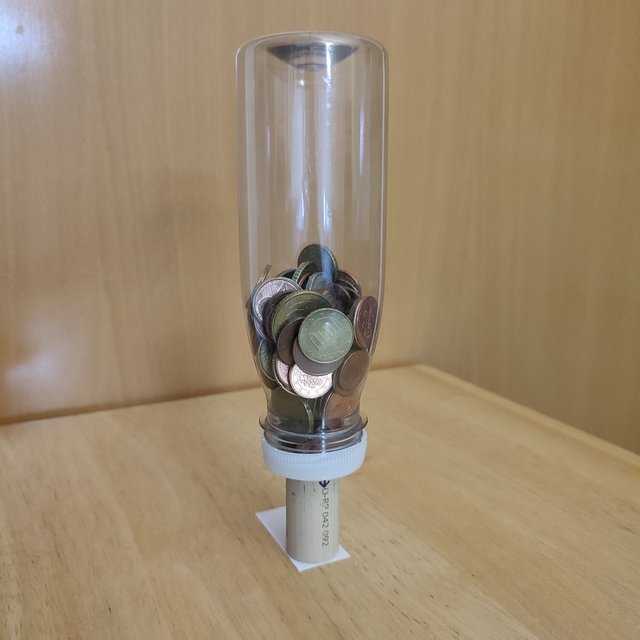
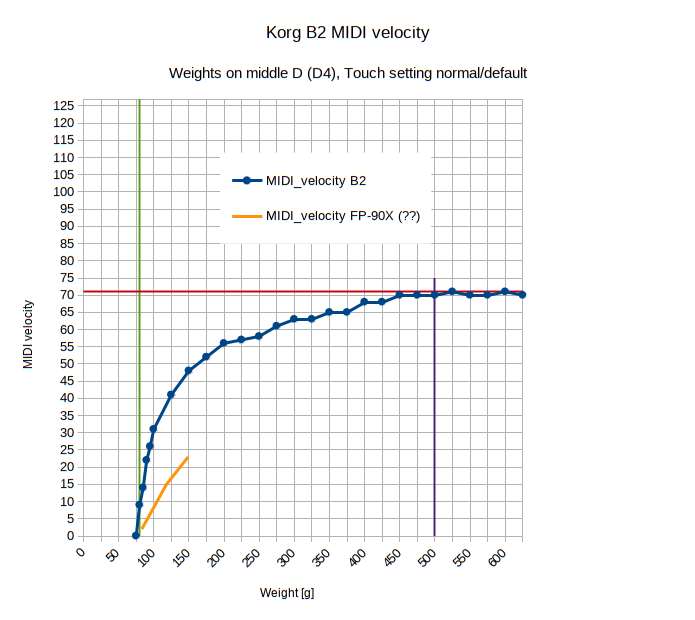
			<content type="html"><![CDATA[<p>An experiment, that has another outcome than expected, mmh.<br />Did you always place the weight at the same position on the white key of the Vidal?<br />See the image of an old thread, where a piece of paper represents the position at the front of a white key:</p><p><span class="postimg"><img src="https://i.postimg.cc/hv5b470P/coins-373g.jpg" alt="https://i.postimg.cc/hv5b470P/coins-373g.jpg" title="https://i.postimg.cc/hv5b470P/coins-373g.jpg"/></span></p><p>The trick is, that a weight &gt;= 500 g is nearly&nbsp; free falling with 9.81 m/s², because is much heavier than the inertia of a common key. See the red asymptote, which indicates a Korg B2 action has <strong>MIDI velocity ~ 70</strong> under these conditions:</p><p><span class="postimg"><img src="https://i.postimg.cc/m2KrqCqQ/Korg-B2-plus-FP-90-X-velocity-weight-helplines.png" alt="https://i.postimg.cc/m2KrqCqQ/Korg-B2-plus-FP-90-X-velocity-weight-helplines.png" title="https://i.postimg.cc/m2KrqCqQ/Korg-B2-plus-FP-90-X-velocity-weight-helplines.png"/></span><br />at <a href="https://forum.pianoworld.com/ubbthreads.php/topics/3300421/re-roland-fp-90x-key-weight.html#Post3300421">https://forum.pianoworld.com/ubbthreads...ost3300421</a></p><p>Did you use the default/normal/power-on velocity curve of the Vidal?</p><p>It needs some practise to set the weight free, yes. Is the variation of a ten times repetition with key c4 and ~ 500 g on the Vidal really so &quot;wide&quot; as you implicated??</p><p>Thanks for your efforts.</p>]]></content>
			<author>
				<name><![CDATA[groovy]]></name>
				<uri>https://forum.modartt.com/profile.php?id=1021</uri>
			</author>
			<updated>2026-04-05T22:24:59Z</updated>
			<id>https://forum.modartt.com/viewtopic.php?pid=1007510#p1007510</id>
		</entry>
		<entry>
			<title type="html"><![CDATA[Re: Vidal MIDI piano controller--user review]]></title>
			<link rel="alternate" href="https://forum.modartt.com/viewtopic.php?pid=1007503#p1007503"/>
			<content type="html"><![CDATA[<div class="quotebox"><cite>groovy wrote:</cite><blockquote><p>Yes, it is all documented in the thread I have already linked.</p><p>No need for the velocitester tool here. Pianoteq contains an elaborated MIDI monitor, <br />which is more than enough to record the MIDI velocity of a single note C4 under a weight of ~ 500 g.</p><p>Please don&#039;t feel under pressure, if you don&#039;t like to do that little experiment. It&#039;s completely ok.</p><p>Cheers</p></blockquote></div><p>I bought a 500 gram calibration weight to try this test, and attached a small, very light plastic cylinder (en emptied dessicant container) using a little silicone, in order to have a weight that would fit within the width of a standard piano key, even though. It was top-heavy (the bottle filled with coins that you used was probably a better idea, but I don&#039;t have an accurate scale, so I bought the calibration weight instead). I then went to velocitest.com to try the experiment. However, regardless of how careful I was or what technique I tried in order to minimize inconsistencies, the tests, even on one single note, produced a wide range of MIDI-value results. Even small movements of my hands, the placement of the weight, holding the key up until ready to allow it to drop from the weight placed upone it, slight wobbles from that rather heavy calibration weight (about 1.1 lbs. I think), changed the outcome of the test.</p><p>So I think that the test using a piece of wood or other rigid object that can cover many keys at once, might be better to determine with some reliability the relative differences in MIDI-sensor response and calculated velocity values, than the single, one-key-at-a-time type of test.</p><p><span class="postimg"><img src="https://i.imgur.com/dq4hirc.jpeg" alt="https://i.imgur.com/dq4hirc.jpeg" title="https://i.imgur.com/dq4hirc.jpeg"/></span></p><p>---</p>]]></content>
			<author>
				<name><![CDATA[Stephen_Doonan]]></name>
				<uri>https://forum.modartt.com/profile.php?id=4838</uri>
			</author>
			<updated>2026-04-05T12:39:55Z</updated>
			<id>https://forum.modartt.com/viewtopic.php?pid=1007503#p1007503</id>
		</entry>
</feed>